





Skip Navigation
Skip to contents

Cancer Res Treat : Cancer Research and Treatment

OPEN ACCESS

Articles

Page Path
HOME > Cancer Res Treat > Volume 51(2); 2019 > Article
Original Article Comparison of Efficacy of Pembrolizumab between Epstein-Barr Virus‒Positive and ‒Negative Relapsed or Refractory Non-Hodgkin Lymphomas
Seok-Jin Kim, MD, PhD1, Jiyeon Hyeon, MD, PhD2, Inju Cho, MD2, Young Hyeh Ko, MD, PhD2, Won Seog Kim, MD, PhD1
Cancer Research and Treatment : Official Journal of Korean Cancer Association 2019;51(2):611-622.
DOI: https://doi.org/10.4143/crt.2018.191
Published online: July 20, 2018

1Division of Hematology-Oncology, Department of Medicine, Samsung Medical Center, Sungkyunkwan University School of Medicine, Seoul, Korea

2Department of Pathology, Samsung Medical Center, Sungkyunkwan University School of Medicine, Seoul, Korea

Correspondence: Won Seog Kim, MD, PhD Division of Hematology/Oncology, Department of Medicine, Samsung Medical Center, Sungkyunkwan University School of Medicine, 81 Irwon-ro, Gangnam-gu, Seoul 06351, Korea
Tel: 82-2-3410-6548 Fax: 82-2-3410-1754 E-mail: wskimsmc@skku.edu
*Seok-Jin Kim and Jiyeon Hyeon contributed equally to this work.
• Received: April 2, 2018   • Accepted: July 17, 2018

Copyright © 2019 by the Korean Cancer Association

This is an Open Access article distributed under the terms of the Creative Commons Attribution Non-Commercial License (http://creativecommons.org/licenses/by-nc/4.0/) which permits unrestricted non-commercial use, distribution, and reproduction in any medium, provided the original work is properly cited.

  • 17,166 Views
  • 633 Download
  • 81 Web of Science
  • 75 Crossref
  • 93 Scopus
prev next
  • Purpose
    Pembrolizumab, a programmed cell death protein 1 (PD1) inhibitor inhibits the interplay between PD1 of T-cell and programmed cell death ligand 1 (PDL1) on tumor cells. Although pembrolizumab has been tried to various subtypes of non-Hodgkin lymphoma (NHL), real-world data about the efficacy of pembrolizumab in NHL patients are limited.
  • Materials and methods
    We analyzed the outcome of 30 relapsed or refractory NHL patients treated with pembrolizumab, and compared the outcome between Epstein-Barr virus (EBV)‒positive and negative subtypes because EBV infection of tumor cells can upregulate PDL1 expression.
  • Results
    Seven patients with EBV-positive NHL showed a response including NK/T-cell lymphoma (6/14, 44%) and primary mediastinal B-cell lymphoma (1/4, 25%) whereas EBV-negative subtypes did not respond such as diffuse large B-cell lymphoma and T-lymphoblastic lymphoma. We also evaluated PDL1 expression using tumor tissue of 76 patients. High PDL1 expression (positive staining of > 50% of tumor cells) was more frequent in NK/T-cell lymphoma and primary mediastinal B-cell lymphoma than other subtypes. Thus, PDL1 expression was significantly higher in EBV-positive (18/32, 56%) than EBV-negative NHL (4/38, 11%, p < 0.001). Furthermore, NK/T-cell lymphoma patients with high PDL1 expression showed a higher response (4/6, 67%) than those with low PDL1 expression (1/5, 20%).
  • Conclusion
    Pembrolizumab could be useful as a salvage treatment for relapsed or refractory EBV-positive NHL, especially NK/T-cell lymphoma. However, its efficacy in EBV-negative NHL with low or absent PDL1 expression is still not clear although pembrolizumab could be a potential treatment option for relapsed or refractory NHL.
Non-Hodgkin lymphoma (NHL) represents a heterogeneous group of malignancies with distinct clinical and pathological features. New treatments have improved the outcomes of NHL, but a substantial number of patients still relapse and require multiple treatments because only a limited number of patients respond to salvage treatment and the response is usually of short duration [1,2]. Furthermore, as intensified salvage chemotherapy is repeated, treatment-related toxicity contributes to long-term morbidity and poor survival outcomes. Thus, there is an unmet need for more effective and less toxic drugs for the treatment of NHL. Recent improvements in the understanding of the evasion of the immune response by tumor cells have led to the identification of immune checkpoint inhibition as a new tool for cancer treatment [3]. The programmed cell death protein 1 (PD1) is an immune checkpoint that regulates the host immune response. The binding of PD1 ligand 1 (PDL1) on tumor cells to PD1 on the surface of effector T-cells transduces inhibitory signals to the T cells, allowing tumor cells to escape antitumor immunity [4]. Therefore, inhibition of this interplay between PD1 and PDL1 can reverse this immune escape and enhance T-cell cytotoxicity against tumor cells. Currently, two monoclonal IgG4 anti-PD1 antibodies, nivolumab and pembrolizumab, are approved by the Food and Drug Administration (FDA) as salvage treatment for solid cancers such as melanoma and non-small cell lung cancer. The FDA has also granted accelerated approval to nivolumab and pembrolizumab for the treatment of relapsed or refractory classical Hodgkin lymphoma (HL). However, data concerning the use of pembrolizumab in patients with NHL are limited because its efficacy in relapsed or refractory NHL has not been determined. In our institute, we have used pembrolizumab to treat patients with various subtypes of relapsed or refractory NHL, and already reported the exciting outcome of one patient with relapsed NK/T-cell lymphoma (NKTCL) in a previous multicenter retrospective study [5]. Since January 2016, we have used pembrolizumab as a salvage treatment for thirty patients with relapsed or refractory NHL. In this study, we retrospectively analyzed their treatment outcome to illustrate our real-world experience with pembrolizumab treatment in relapsed or refractory NHL outside of clinical trials.
1. Patients and treatment
Thirty consecutive patients with relapsed or refractory NHL were treated with pembrolizumab at the Samsung Medical Center between January 2016 and September 2017. Informed consent for the use of pembrolizumab was obtained from all patients. Because the cost of pembrolizumab is not reimbursed by health insurance in Korea, a fixed low dose of 100 mg was administered to 27 patients while three patients received the recommended dose of 200 mg. The treatment cycle was repeated every 3 weeks. The response was assessed using 2-deoxy-2-fluorine-18-fluoro-D-glucose positron emission tomography integrated with computed tomography and computed tomography according to standard criteria. In most patients, the first response evaluation was performed after the second or third cycle of treatment [6]. If signs of rapid deterioration were observed, response evaluation was performed earlier than the planned date. For patients with NKTCL, blood Epstein–Barr virus (EBV) DNA titer was also quantified as previously reported as an indirect biomarker of the extent of disease [7].
2. Assessment of PDL1 expression in NHL
We assessed PDL1 expression of tumor cells by immunohistochemistry (IHC) to evaluate the extent of PDL1 expression in various subtypes of NHL. Thus, PDL1 expression was assessed in relapsed or refractory NHL patients (n=76) for whom paraffin-embedded tissue blocks were available for IHC. Most tissue samples were from archived tissue samples in our lymphoma registry that were obtained as routine clinical practice at the time of diagnosis (n=71), and only five cases were from obtained at relapse or progression. After IHC, we analyzed the proportion of cells in each tumor subtype that expressed PDL1 to determine whether PDL1 expression differed according to subtype of NHL. We also evaluated the EBV positivity of tumor cells, correlating the results of EBV in situ hybridization with PDL1 expression for each subtype of NHL. These 76 patients included 21 patients treated with pembrolizumab who were analyzed for response evaluation. Thus, we could evaluate the PDL1 expression of tumor cells in patients receiving pembrolizu-mab to determine whether the response to pembrolizumab was correlated with PDL1 expression.
3. IHC for PDL1 and EBV positivity
Two assays including monoclonal antibodies against PDL1 were used: the Ventana PDL1 (SP142) assay (1:25, rabbit antihuman PDL1/CD274 monoclonal antibody, clone SP142, Ventana, Tucson, AZ) and the PDL1 IHC 22C3 pharmDx assay, which includes the murine 22C3 anti-human PDL1 antibody (Dako, Carpinteria, CA). PDL1 IHC using the Ventana PDL1 assay was performed on an automated immunostainer (Benchmark, Ventana) according to the manufacturer’s instructions. In some cases, PDL1 IHC was performed using the PDL1 IHC 22C3 pharmDx kit using a Link 48 autostainer according to the manufacturer’s instructions. Because it was difficult to identify tumor cells precisely when observing only hematoxylin and eosin (H&E) stained slides, PDL1 expression on tumor cells was investigated by comparing H&E slides. The proportion of PDL1-positive cells was estimated as a percentage of total tumor cells; tumor cells typically showed membranous staining with a variable component of cytoplasmic staining. The percentage of tumor cells positively stained for PDL1 was determined by pathologists. Because there are no established criteria for high PDL1 expression in lymphoma, we used the cutoff value of 50% which was suggested by the manufacturer’s instructions of PDL1 IHC 22C3 pharmDx kit [8]. Thus, PDL1 expression was defined as follows: No expression (PDL1-positive tumor cells < 1%), low expression (PDL1-positive tumor cells 1%-49%), and high expression (PDL1-positive tumor cells ≥ 50%).
4. Study parameters
The response of each patient was classified based on the best response during pembrolizumab treatment, regardless of the final outcome. The overall response rate (ORR) was based on the number of patients who achieved a complete response (CR) or a partial response (PR). The toxicity profiles of pembrolizumab were determined based on review of the medical records. The number of previous treatments was defined as the total number of cycles of treatment from the first-line chemotherapy to the last chemotherapy before pembrolizumab. Radiotherapy or autologous or allogeneic stem cell transplantation (SCT) were not included in the number of previous treatments because they were used as adjuvant or consolidation therapy. The characteristics of patients including age, performance status, stage, and absolute lymphocyte count were recorded at the time of pembrolizumab treatment, not at the time of diagnosis. Time to pembrolizumab was defined as the interval between the date of diagnosis and the date of the first infusion of pembrolizumab. Post-pembrolizumab survival was defined as the time between the date of first infusion of pembrolizumab and the date of last follow-up or death from any cause. The participants’ disease status and survival were updated on December 31, 2017.
5. Ethical statement
The study was approved by the Institutional Review Board of Samsung Medical Center (IRB No. 2017-11-105) and performed in accordance with the principles of the Declaration of Helsinki. The informed consent was waived.
1. Characteristics of patients before pembrolizumab
The median age of patients at the time of pembrolizumab treatment was 49 years (range, 18 to 80 years) and most were men (n=27). The histologic subtypes of tumor were diffuse large B-cell lymphoma (DLBCL; n=10), primary mediastinal large B-cell lymphoma (PMBCL; n=4), NKTCL (n=14), and T-cell lymphoblastic lymphoma (T-LBL; n=2). Most patients had stage IV disease (n=26) with widespread organ involvement (≥ 2 sites of extranodal involvement, n=25) (Table 1). The majority of patients had been heavily treated before pembrolizumab treatment: the median number of previous chemotherapy treatments excluding SCT was 4 (range, 1 to 10), and 16 patients had undergone autologous or allogeneic SCT (Table 1). Five patients had relapsed after allogeneic SCT, including one patient who underwent haploidentical SCT. All patients with DLBCL and T-LBL showed negativity for EBV whereas all cases of NKTCL and one case of PMBCL were positive for EBV (Table 1).
2. Response to pembrolizumab
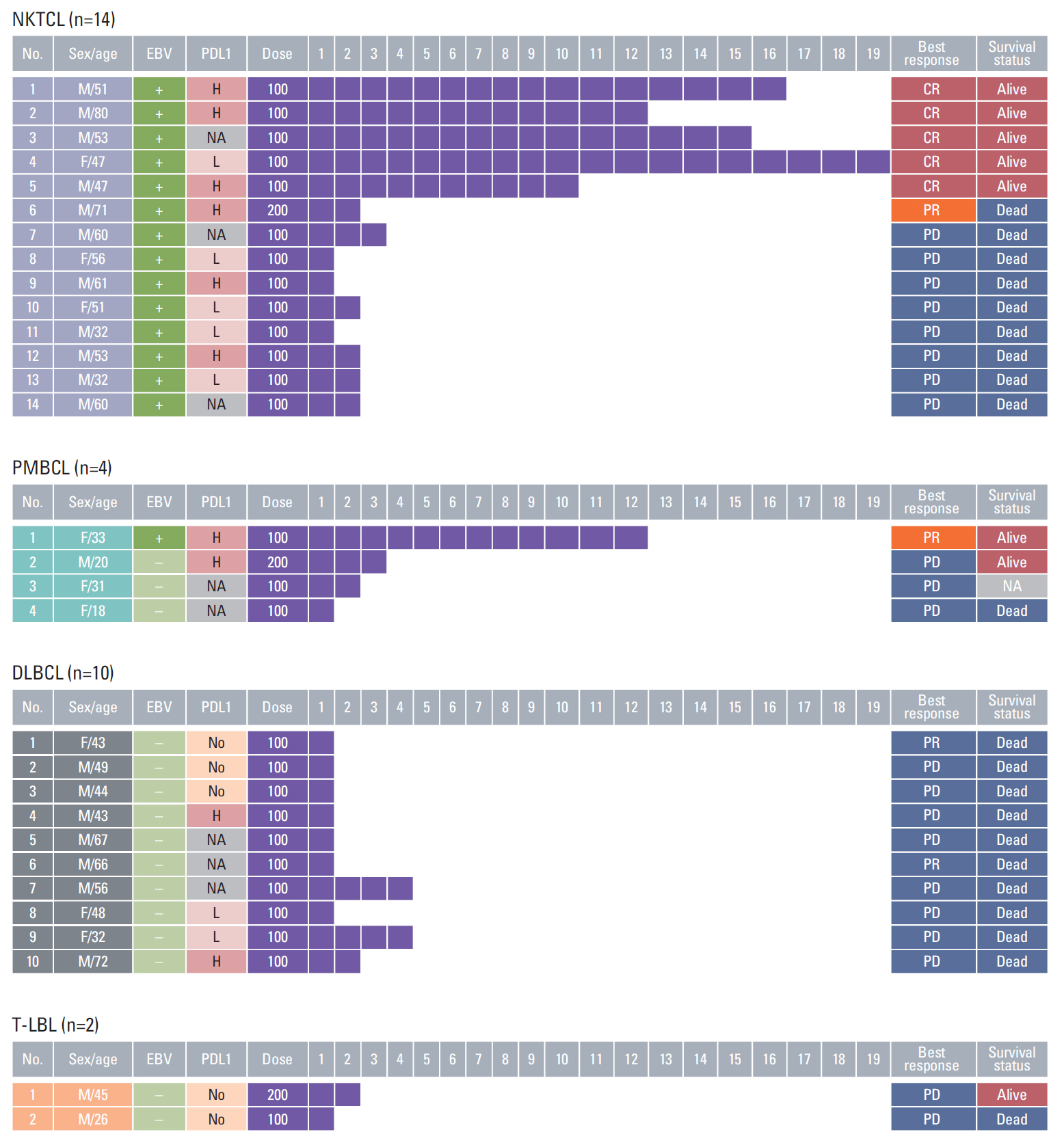
All patients with DLBCL rapidly progressed during pembrolizumab treatment and died. Therefore, more than half the patients discontinued pembrolizumab after their first cycle (median number of cycle, 1; range, 1 to 4). The two patients with T-LBL had relapsed after haploidentical and unrelated allogeneic SCT and received pembrolizumab as a salvage treatment. However, their disease rapidly progressed after the first of second cycle of pembrolizumab. Of the four patients with PMBCL, case 1 showed a PR, and completed the 12th cycles of pembrolizumab (Fig. 1). She is currently in the state of ongoing treatment. On the contrary to other tumor subtypes, six NKTCL patients responded (5 CR, 1 PR; ORR, 44%). Case 1 who had relapsed after unrelated allogeneic SCT, showed a CR: this case was included in a previous study [5]. Since then, he has continued to receive pembrolizumab up to 16 cycles, and has shown no clinical or radiologic evidence of disease relapse during treatment (Fig. 1). Case 2, an 80-year-old man who was diagnosed with stage IV NKTCL only received a half-dose of SMILE (steroid, methotrexate, ifosfamide, L-asparaginase, and etoposide) chemotherapy because he was elderly and unsuitable for intensified chemotherapy. After his third cycle of SMILE chemotherapy, his disease progressed with an elevation in blood EBV DNA titer (90,568 copies/mL). However, he achieved CR with an undetectable level of blood EBV DNA after the third cycle of pembrolizumab and completed 12 cycles. Three patients (case 3-5) also continued to receive pembrolizumab up to 19th cycle (Fig. 1). Case 6 showed a PR after the second cycle of pembrolizumab, but the patient refused further treatment for financial reasons; his disease progressed, and he died (Fig. 1). Most patients who showed disease progression after one to three cycles of pembrolizumab died.
3. Adverse events during pembrolizumab treatment
Case 1 with NKTCL developed a grade II skin rash after the third cycle of pembrolizumab treatment. The biopsy of skin lesion showed hydropic degeneration and basal vacuolization consistent with graft-versus-host disease (GVHD). Although the time to onset of skin lesion was longer than 1 year because he underwent allogeneic SCT from a matched unrelated donor 10.6 months before pembrolizumab treatment, we reported this event as an acute GVHD in a previous study [5]. The reason was that he did not have any sign of acute GVHD before pembrolizumab and his skin manifestation was not consistent with chronic GVHD. His skin lesions improved with corticosteroid treatment and further therapy was unhindered. In contrast, cases 1 and 2 with T-LBL did not develop any sign of GVHD despite having undergone haploidentical and unrelated allogeneic SCT 11.0 and 6.2 months before pembrolizumab treatment. Case 9 with NKTCL involving the small intestine developed bowel perforation after the first cycle of pembrolizumab and died as a result of sepsis (Fig. 1).
4. Association of PDL1 with EBV positivity
PDL1 expression was evaluated in archived tumor tissue samples from 76 patients with NHL including 21 patients treated with pembrolizumab. The proportion of tumors with high PDL1 expression differed according to the subtype of NHL. Thus, high PDL1 expression was more frequent in NKTCL (15/28, 54%), PMBCL (4/6, 67%), and peripheral T-cell lymphoma (PTCL; 2/7, 29%) than in DLBCL (2/18, 11%) and T-LBL (0/8, 0%). Although the numbers were small, high PDL1 expression was observed in subcutaneous panniculitis-like T-cell lymphoma and angioimmunoblastic T-cell lymphoma unlike primary central nervous system (CNS) DLBCL (0/3), mantle cell lymphoma (0/2), and enteropathy-associated T-cell lymphoma (0/1) (Fig. 2A). Although six patients were not evaluated for EBV in situ hybridization including DLBCL (n=4) and PMBCL (n=2), EBV-positivity was more frequent in NKTCL (28/28, 100%) and PTCL (3/7, 43%) than other subtypes. EBV-positive NHL included a significantly higher proportion of tumors with high PDL1 expression (18/32, 56%) compared with EBV-negative NHL (4/38, 11%, p < 0.001) (Fig. 2B). Thus, these results suggest the association of EBV-positivity with PDL1 expression although EBV-positivity was not evaluated in four cases of high PDL1 expression due to lack of available tissue (DLBCL and PMBCL) (Fig. 2A).
5. Association of PDL1 and EBV positivity with treatment outcome
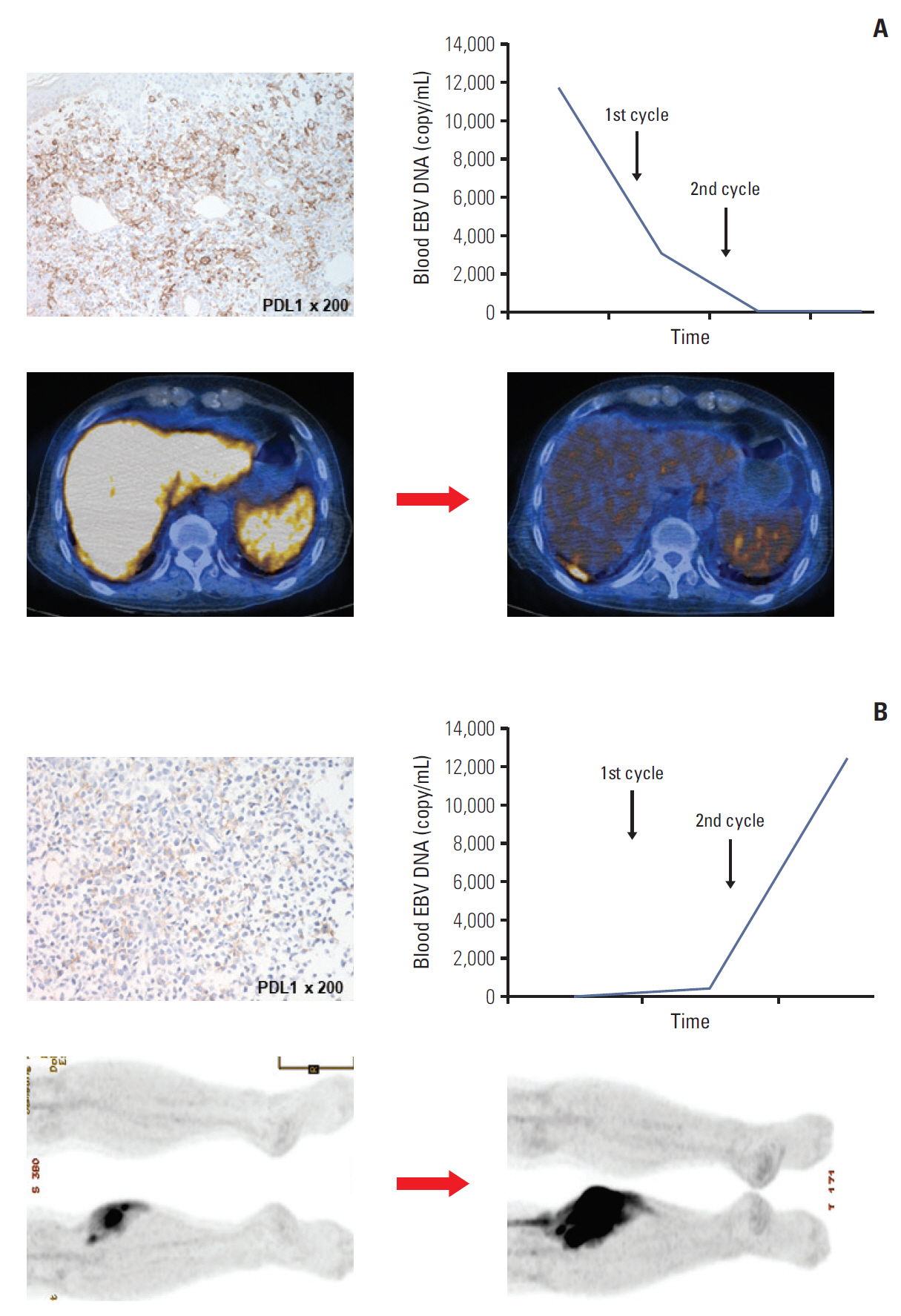
When we dichotomized 30 patients receiving pembrolizumab into two groups according to the EBV positivity, seven patients with EBV-positive tumor responded to pembrolizumab (7/15) whereas all patients with EBV-negative tumor failed to respond (0/15) (Table 2). Thus, NKTCL (6/14, 44%) and PMBCL (1/4, 25%) showed higher ORR than DLBCL (0/10, 0%) and T-LBL (0/2, 0%). This higher response to pembrolizumab was associated with more frequent expression of PDL1 in EBV-positive tumors. Indeed, aforementioned case 1 of PMBCL who had EBV-positive disease and high PDL1 expression showed a PR to pembrolizumab (Fig. 1). The different proportions of high PDL1 expression in different subtypes of NHL tumors correlated with their response to pembrolizumab. Of 21 pembrolizumab-treated patients whose PDL1 expression was analyzed, five cases with high PDL1 expression responded to pembrolizumab (5/10, 50%) whereas only two cases with low PDL1 expression responded (2/11, 18%); however, this difference was not significant (p=0.183). Even in patients with NKTCL, the ORR was different between those with high (4/6, 67%) and low PDL1 expression (1/5, 20%). For example, case 6 of NKTCL with high PDL1 expression showed a PR with undetectable levels of EBV DNA in blood after pembrolizumab treatment (Fig. 3A), whereas case 10 with low PDL1 expression did not respond (Fig. 3B). However, this difference of response based on PDL1 expression could not be statistically analyzed due to small number of patients.
In our study, pembrolizumab was used in different NHL subtypes, and their response to pembrolizumab was different. Thus, the ORR of NKTCL (6/14, 44%) was higher than that of PMBCL (1/4, 25%), DLBCL (0/10, 0%), or T-LBL (0/2, 0%). Although the number of patients in each subtype was small, our findings are consistent with those of a previous case series reporting outstanding outcomes of pembrolizumab treatment in NKTCL patients (Table 3). Actually, pembrolizumab as an off-label treatment for relapsed or refractory T- or NK-cell NHL achieved CR [5,9,10]. Of the patients with PMBCL, case 1 who was EBV positive with high PDL1 expression responded to pembrolizumab (Fig. 1). However, the other three patients with PMBCL, including one patient with high PDL1 expression, failed to respond. In a previous phase 1b study, the ORR to pembrolizumab was 41% (7/17) in relapsed or refractory PMBCL [11]. Although our response rate in PMBCL was inferior to these phase 1b results, the number of patients in our study was too small to draw definite conclusions about the efficacy of pembrolizumab in PMBCL. On the other hand, a recent phase II study using pembrolizumab plus rituximab reported 80% of ORR in relapsed or refractory follicular lymphoma [12]. This suggests the role of pembrolizumab as a combination treatment with other drugs. Indeed, a patient with double-hit lymphoma receiving pembrolizumab and lenalidomide achieved CR [13]. In our study, although not all patients responded to pembrolizumab, six cases of NKTCL did respond. Therefore, given that NKTCL usually follows an aggressive clinical course after relapse and there is currently no effective salvage treatment for NKTCL, our findings suggested that pembrolizumab could be a useful treatment option for relapsed or refractory NKTCL.
This different response of different NHL subtypes to pembrolizumab could be related to their different levels of PDL1 expression. Thus, our study analyzed the extent of PDL1 expression in 76 patients with NHL including 21 patients who received pembrolizumab. The frequency of high PDL1 expression was very rare in patients with DLBCL (2/18, 11%) and mantle cell lymphoma (0/2, 0%) in our study. Previous studies also reported the absence of PDL1 expression in mantle cell lymphoma [14,15]. Although those studies showed higher frequency of PDL1 expression in DLBCL than that of our study, it might be related with low cutoff value (5%) for PDL1 expression (Table 4). Actually, a study analyzing 1,253 patients with DLBCL showed the same incidence of PDL1 expression (132/1,253, 11%) as ours and the study used 30% of cutoff value [16]. Thus, the poor response to pembrolizumab in DLBCL patients of our study could be explained the low frequency of PDL1 expression. The main mechanism of PDL1 overexpression was amplification of chromosome 9p24.1, and is commonly observed in patients with HL [17]. However, the rearrangement of 9p24.1 leading to PDL1 overexpression was more frequently found in PMBCL and primary CNS DLBCL [18,19]. Our study also showed frequent PDL1 expression in PMBCL comparable to that of previous studies [14,15]. However, three cases of primary CNS DLBCL showed no expression of PDL1 unlike a previous study reporting 38% in Western patients [20]. This might be related with ethnic difference as well as a different cutoff value (50% vs. 1%). Thus, it should be evaluated in the future study using a larger study population. Our study showed high PDL1 expression in more than 50% of patients with NKTCL, and previous studies also reported high frequency of PDL1 expression [21,22]. This could be related with that tumor cells of NKTCL are invariably infected with EBV because EBV infection of tumor cells and activation of the inflammation-related JAK/STAT pathway also could upregulate PDL1 expression [24]. Other subtypes of NHL also had EBV-positive tumor cells although its frequency was lower than NKTCL. The frequency of EBV-positivity was known as approximately 10% in DLBCL, thus, some cases of EBV-positive DLBCL might have PDL1 expression [16]. However, considering poor response to pembrolizumab in DLBCL patients, even in case of high PDL1 expression, pembrolizumab should be very cautiously used in DLBCL patients (Fig. 1). Thus, it should be determined whether PDL1 is expressed on lymphoma cells before pembrolizumab treatment is initiated. Although only two patients with T-LBL received pembrolizumab, it cannot be recommended for this disease entity because PDL1 expression is absent in T-LBL. Overall, these results suggest that PDL1 expression on lymphoma cells might be useful as a biomarker predicting the response to pembrolizumab.
However, our study has several limitations as follows. First, we defined high PDL1 expression based on the cutoff value of 50% because there are no established criteria for high PDL1 expression in lymphoma. Thus, the frequency of high PDL1 expression in lymphoma patients might become different according to the cutoff values. However, a previous study for the development of a companion diagnostic PDL1 IHC assay for pembrolizumab therapy in non-small-cell lung cancer (NSCLC) showed the treatment effect of pembrolizumab was substantial in patients with ≥ 50% of PDL1-postitive tumor cells [25]. Furthermore, a phase III trial with pembrolizumab for NSCLC also reported a significant association of longer survival outcome with PDL1 expression on at least 50% of tumor cells [26]. Therefore, our cutoff value could be used to define high PDL1 expression in lymphoma although further studies with a larger study population should be performed to determine the correlation of response to pembrolizumab with PDL1 expression in lymphoma patients. Second, we used two types of antibodies to assess PDL1 expression. This might influence the results of PDL1 expression in our study. However, our pathology confirmed no difference of efficacy in analyzing the PDL1 expression between two types of assay. Furthermore, given the range of low and high PDL1 expression was wide (1%-49% vs. ≥ 50%), the use of two types of IHC assay might not complicate interpretation of IHC results. Third, most tissues samples for PDL1 expression were obtained from the time of diagnosis. Considering PDL1 expression might be different between diagnosis and relapse/progression, some patients showing the discrepancy of response and PDL1 expression might be associated with this limitation. Fourth, a substantial number of patients discontinued to receive pembrolizumab due to disease progression in our study (Fig. 1). Although it could be interpreted as a lack of efficacy in those patients, the probability of atypical response patterns mimicking disease progression could exist because immune-reaction inducing tumor-flare or pseudoprogression could be found in the treatment with pembrolizumab in other solid tumors. Thus, response evaluation and the assessment of disease status should be more careful in lymphoma patients receiving pembrolizumab as the refinement of the Lugano Classification Response Criteria for Lymphoma was proposed in the era of therapy with immune checkpoint inhibitor [27]. Fifth, the number of each subtype was small, especially T-LBL, and there is lack of data about the outcome of other subtypes such as mantle cell lymphoma. Thus, future study with a larger study population including more subtypes should be warranted. Lastly, the dosage of pembrolizumab given to most patients (100 mg every 3 weeks) was lower than that recommended (200 mg every 3 weeks). However, in our study the efficacy of treatment with pembrolizumab was comparable with those reported in previous studies (Table 2), and was consistent with the results of a study suggesting that low-dose pembrolizumab (100 mg every 3 weeks) could be effective for relapsed or refractory HL, with minimal toxicity [28]. In fact, when using this low dose of pembrolizumab we observed six responders (2 CR, 4 PR) out of eight patients with relapsed or refractory HL who failed treatment with brentuximab vedotin and autologous SCT (ORR, 75%) (S1 Table). The outcome of our low-dose treatment was comparable to that of previous phase II studies of relapsed or refractory HL that reported an ORR of 65% (16% CR) using 10 mg/kg of pembrolizumab every 2 weeks [29] and an ORR of 69% (22.4% CR) using 200 mg of pembrolizumab every 3 weeks [30].
None of the patients in our study showed any grade 3 or 4 hematologic or nonhematologic toxicities, and their causes of death were related to disease progression. Although one patient developed a bowel perforation, that patient had previously experienced bowel perforation during salvage chemotherapy before initiation of pembrolizumab treatment. Therefore, the toxicity of pembrolizumab was manageable, which might be because we used a low dose of 100 mg of pembrolizumab every 3 weeks, although a previous study using 10 mg/kg of pembrolizumab every 2 weeks reported five cases of grade 3 drug-related adverse events (16%). Furthermore, five patients in our study had undergone unrelated or haploidentical allogeneic SCT before receiving pembrolizumab, but only one patient developed grade II acute GVHD (case 1 with NKTCL) (Fig. 1). This might be related to the lower dose of pembrolizumab and be consistent with the safety of PD1 blockade after allogeneic SCT [10].
In conclusion, pembrolizumab could be useful as a salvage treatment for relapsed or refractory EBV-positive NHL, especially NKTCL. However, its efficacy in EBV-negative NHL with low or absent PDL1 expression is still not clear although pembrolizumab could be a potential treatment option for relapsed or refractory NHL.
Supplementary materials are available at Cancer Research and Treatment website (http://www.e-crt.org).

Conflict of interest relevant to this article was not reported.

Acknowledgements
This study was supported by a grant from the Basic Science Research Program through the National Research Foundation of Korea (NRF), which is funded by the Ministry of Education, Science, and Technology (NRF-2017R1A2B4005136). We also give thanks to all colleagues for participating in the research, and express our gratitude to the 20-20 project of the Samsung Medical Center.
Fig. 1.
Clinical outcome and treatment cycles of NK/T-cell lymphoma (NKTCL), primary mediastinal B-cell lymphoma (PMBCL), diffuse large B-cell lymphoma (DLBCL), and T-lymphoblastic lymphoma (T-LBL). EBV, Epstein-Barr virus; PDL1, programmed cell death ligand 1; H, high; CR, complete response; NA, not available; L, low; PR, partial response; PD, progressive disease.
crt-2018-191f1.jpg
Fig. 2.
(A) Comparison of programmed cell death ligand 1 (PDL1) expression in 76 patients with non-Hodgkin lymphoma shows different frequencies of high (≥ 50% of PDL1-positive tumor cells), low (1%-49% of PDL1-positive tumor cells), and no expression. High PDL1 expression is more frequent in NK/T-cell lymphoma (NKTCL; 15/28, 54%) and primary mediastinal B-cell lymphoma (PMBCL; 4/6, 67%) than in peripheral T-cell lymphoma (PTCL; 2/7, 28%), diffuse large B-cell lymphoma (DLBCL; 2/18, 11%), and T-lymphoblastic lymphoma (T-LBL; 0/8, 0%). No case of PDL1 high expression is observed in primary central nervous system diffuse large B-cell lymphoma (CNS DLBCL; 0/3), mantle cell lymphoma (MCL, 0/2), or enteropathy-associated T-cell lymphoma (EATL; 0/1). However, subcutaneous panniculitis-like T-cell lymphoma (SPTCL; 2/2) and angioimmunoblastic T-cell lymphoma (AITL; 1/1) show high PDL1 expression. (B) Epstein-Barr virus (EBV)–positive non-Hodgkin lymphoma (NHL) shows a significantly higher proportion of high PDL1 expression (18/32, 56%) than EBV-negative NHL (4/38, 11%, p < 0.001).
crt-2018-191f2.jpg
Fig. 3.
(A) Immunohistochemistry for programmed cell death ligand 1 (PDL1) shows ≥ 50% of tumor cells positively stained (brown membranous staining) in a case of extranodal NK/T-cell lymphoma (top left); decrease in blood Epstein-Barr virus (EBV) DNA level after pembrolizumab treatment (top right); decrease in fluorodeoxyglucose (FDG) uptake in liver and spleen after pembrolizumab treatment (bottom). (B) Immunohistochemistry for PDL1 shows < 1% of tumor cells positively stained in a case of extranodal NK/T-cell lymphoma (top left); increase in blood EBV DNA level even after pembrolizumab treatment (top right); increase in the extent and intensity of FDG uptake in a soft tissue mass in an extremity after pembrolizumab treatment (bottom).
crt-2018-191f3.jpg
Table 1.
Clinical characteristics of patients at the time of pembrolizumab treatment
Total (n=30) DLBCL (n=10) PMBCL (n=4) NKTCL (n=14) T-LBL (n=2)
Age (yr)
 ≤ 60 22 7 4 9 2
 > 60 8 3 0 5 0
Sex
 Male 21 7 1 11 2
 Female 9 3 3 3 0
Performance status
 ECOG 0/1 9 1 3 4 1
 ECOG ≥ 2 21 9 1 10 1
Stage
 I/II 2/2 0/0 1/1 2 0
 III/IV 0/26 0/10 0/2 12 2
No. of extranodal involvements
 0/1 5 1 2 2 0
 ≥ 2 25 9 2 12 2
Serum LDH
 Normal 10 2 1 5 0
 Increased 20 8 3 9 2
IPI
 Low/Low-intermediate 4/2 0/1 2/0 2/0 0/1
 High-intermediate/High 8/16 1/8 1/1 5/7 1/0
No. of previous treatments, median (range) 4 (1-10) 5 (2-10) 4 (3-6) 3 (1-7) 2 (2-3)
Previous SCT 14 3 2 6 2
 Autologous 9 3 2 4 0
 Allogeneic 4 0 0 2 1
 Both 1 0 0 0 1
Time to pembrolizumab, median (mo) 17.0 12.2 33.7 19.0 19.9
EBV
 Positive 15 0 1 14 0
 Negative 15 10 3 0 2

DLBCL, diffuse large B-cell lymphoma; PMBCL, primary mediastinal B-cell lymphoma; NKTCL, NK/T-cell lymphoma; T-LBL, T-lymphoblastic lymphoma; ECOG, Eastern Cooperative Oncology Group; LDH, lactate dehydrogenase; IPI, International Prognostic Index; SCT, stem cell transplantation; EBV, Epstein-Barr virus.

Table 2.
EBV positivity and response to pembrolizumab treatment
Total (n=30) EBV
Positive (n=15) Negative (n=15)
Subtype
 DLBCL 10 0 10
 PMBCL 4 1 3
 NKTCL 14 14 0
 T-LBL 2 0 2
PDL1 expression
 High 10 7 3
 Low 7 5 2
 No expression 5 0 5
 Not evaluated 8 3 5
Response
 Complete response 5 5 0
 Partial response 2 2 0
 Stable disease 0 0 0
 Progressive disease 23 8 15

EBV, Epstein-Barr virus; DLBCL, diffuse large B-cell lymphoma; PMBCL, primary mediastinal B-cell lymphoma; NKTCL, NK/T-cell lymphoma; T-LBL, T-lymphoblastic lymphoma; PDL1, programmed cell death ligand 1.

Table 3.
Pembrolizumab in relapsed or refractory non-Hodgkin lymphoma
Study Author Disease No. Dose Response ORR
Case series Kwong et al. [5] NKTCL 7 100 mg every 3 wk 5 CR, 2 PR 100%
Case report Lai et al. [9] NKTCL 1 2 mg/kg every 3 wk CR: alive without relapse -
Case report Chan et al. [10] ALCL 1 2 mg/kg every 3 wk CR -
Case report Chan et al. [13] Double-hit lymphoma 1 Pembrolizumab 100 mg every 3 wk plus lenalidomide 15 mg daily CR -
Phase 1b trial Zinzani et al. [11] PMBCL 18 200 mg every 3 wk 2 CR, 5 PR 41% (7 of 17 evaluable patients)
Phase II Ding et al. [23] CLL (16) or Richter transformation (9) 25 200 mg every 3 wk CLL: no response Transformed CLL: 2 CR/2 PR CLL: 0% (0/16) Transformed CLL: 44% (4/9)
Phase II Nastoupil et al. [12] Follicular lymphoma 30 200 mg every 3 wk plus rituximab 375 mg/m2 D1, 8, 15, 22 CR 60% 80%

ORR, overall response rate; NKTCL, NK/T-cell lymphoma; CR, complete response; PR, partial response; ALCL, anaplastic large cell lymphoma; PMBCL, primary mediastinal B-cell lymphoma; CLL, chronic lymphocytic leukemia.

Table 4.
PDL1 expression in non-Hodgkin lymphomas
Cutoff (%) DLBCL PMBCL MCL CNS DLBCL NKTCL T-LBL PTCL SPTCL AITL EATL
Our study ≥ 50 2/18 (11) 4/6 (67) 0/2 (0) 0/3 (0) 15/28 (54) 0/8 (0) 2/7 (29) 2/2 (100) 1/1 (100) 0/1 (0)
Vranic et al. [15] ≥ 5 13/26 (50) 3/3 (100) 0/9 (0) - - - 3/11 (28) - - -
Menter et al. [14] ≥ 5 80/260 (31) 12/33 (36) 0/35 (0) - - - - - - -
Kiyasu et al. [16] ≥ 30 132/1,253 (11) - - - - - - - - -
Jo et al. [21] ≥ 5 - - - - 63/79 (79) - - - - -
Kim et al. [22] ≥ 10 - - - - 41/73 (56) - - - - -
Four et al. [20] ≥ 1 - - - 12/32 (38) - - - - - -

Values are presented as number (%). PDL1, programmed cell death ligand 1; DLBCL, diffuse large B-cell lymphoma; PMBCL, primary mediastinal B-cell lymphoma; MCL, mantle cell lymphoma; CNS, central nervous system; NKTCL, NK/T-cell lymphoma; T-LBL, T-lymphoblastic lymphoma; PTCL, peripheral T-cell lymphoma; SPTCL, subcutaneous panniculitis-like T-cell lymphoma; AITL, angioimmunoblastic T-cell lymphoma; EATL, enteropathy-associated T-cell lymphoma.

  • 1. Mak V, Hamm J, Chhanabhai M, Shenkier T, Klasa R, Sehn LH, et al. Survival of patients with peripheral T-cell lymphoma after first relapse or progression: spectrum of disease and rare long-term survivors. J Clin Oncol. 2013;31:1970–6. ArticlePubMed
  • 2. Crump M, Neelapu SS, Farooq U, Van Den Neste E, Kuruvilla J, Westin J, et al. Outcomes in refractory diffuse large B-cell lymphoma: results from the international SCHOLAR-1 study. Blood. 2017;130:1800–8. ArticlePubMedPMC
  • 3. Weber J. Immune checkpoint proteins: a new therapeutic paradigm for cancer--preclinical background: CTLA-4 and PD-1 blockade. Semin Oncol. 2010;37:430–9. ArticlePubMed
  • 4. Chen L, Flies DB. Molecular mechanisms of T cell co-stimulation and co-inhibition. Nat Rev Immunol. 2013;13:227–42. ArticlePubMedPMCPDF
  • 5. Kwong YL, Chan TS, Tan D, Kim SJ, Poon LM, Mow B, et al. PD1 blockade with pembrolizumab is highly effective in relapsed or refractory NK/T-cell lymphoma failing l-asparaginase. Blood. 2017;129:2437–42. ArticlePubMed
  • 6. Cheson BD, Fisher RI, Barrington SF, Cavalli F, Schwartz LH, Zucca E, et al. Recommendations for initial evaluation, staging, and response assessment of Hodgkin and non-Hodgkin lymphoma: the Lugano classification. J Clin Oncol. 2014;32:3059–68. ArticlePubMedPMC
  • 7. Kim SJ, Choi JY, Hyun SH, Ki CS, Oh D, Ahn YC, et al. Risk stratification on the basis of Deauville score on PET-CT and the presence of Epstein-Barr virus DNA after completion of primary treatment for extranodal natural killer/T-cell lymphoma, nasal type: a multicentre, retrospective analysis. Lancet Haematol. 2015;2:e66–74. ArticlePubMed
  • 8. Dako North America. PD-L1 IHC 22C3 pharmDx (package insert). Carpinteria, CA: Dako North America; 2015.
  • 9. Lai J, Xu P, Jiang X, Zhou S, Liu A. Successful treatment with anti-programmed-death-1 antibody in a relapsed natural killer/T-cell lymphoma patient with multi-line resistance: a case report. BMC Cancer. 2017;17:507.ArticlePubMedPMCPDF
  • 10. Chan TS, Khong PL, Kwong YL. Pembrolizumab for relapsed anaplastic large cell lymphoma after allogeneic haematopoietic stem cell transplantation: efficacy and safety. Ann Hematol. 2016;95:1913–5. ArticlePubMedPDF
  • 11. Zinzani PL, Ribrag V, Moskowitz CH, Michot JM, Kuruvilla J, Balakumaran A, et al. Safety and tolerability of pembrolizumab in patients with relapsed/refractory primary mediastinal large B-cell lymphoma. Blood. 2017;130:267–70. ArticlePubMedPMC
  • 12. Nastoupil LJ, Westin J, Fowler N, Fanale M, Samaniego F, Oki Y, et al. High response rates with pembrolizumab in combination with rituximab in patients with relapsed follicular lymphoma: interim results of an on open-label, phase II study. Hematol Oncol. 2017;35(Suppl 2):120–1. Article
  • 13. Chan TS, Khong PL, Kwong YL. Pembrolizumab and lenalidomide induced remission in refractory double-hit lymphoma. Ann Hematol. 2016;95:1917–8. ArticlePubMedPDF
  • 14. Menter T, Bodmer-Haecki A, Dirnhofer S, Tzankov A. Evaluation of the diagnostic and prognostic value of PDL1 expression in Hodgkin and B-cell lymphomas. Hum Pathol. 2016;54:17–24. ArticlePubMed
  • 15. Vranic S, Ghosh N, Kimbrough J, Bilalovic N, Bender R, Arguello D, et al. PD-L1 status in refractory lymphomas. PLoS One. 2016;11:e0166266ArticlePubMedPMC
  • 16. Kiyasu J, Miyoshi H, Hirata A, Arakawa F, Ichikawa A, Niino D, et al. Expression of programmed cell death ligand 1 is associated with poor overall survival in patients with diffuse large B-cell lymphoma. Blood. 2015;126:2193–201. ArticlePubMedPMC
  • 17. Roemer MG, Advani RH, Ligon AH, Natkunam Y, Redd RA, Homer H, et al. PD-L1 and PD-L2 genetic alterations define classical Hodgkin lymphoma and predict outcome. J Clin Oncol. 2016;34:2690–7. ArticlePubMedPMC
  • 18. Twa DD, Chan FC, Ben-Neriah S, Woolcock BW, Mottok A, Tan KL, et al. Genomic rearrangements involving programmed death ligands are recurrent in primary mediastinal large B-cell lymphoma. Blood. 2014;123:2062–5. ArticlePubMed
  • 19. Chapuy B, Roemer MG, Stewart C, Tan Y, Abo RP, Zhang L, et al. Targetable genetic features of primary testicular and primary central nervous system lymphomas. Blood. 2016;127:869–81. ArticlePubMedPMC
  • 20. Four M, Cacheux V, Tempier A, Platero D, Fabbro M, Marin G, et al. PD1 and PDL1 expression in primary central nervous system diffuse large B-cell lymphoma are frequent and expression of PD1 predicts poor survival. Hematol Oncol. 2017;35:487–96. ArticlePubMed
  • 21. Jo JC, Kim M, Choi Y, Kim HJ, Kim JE, Chae SW, et al. Expression of programmed cell death 1 and programmed cell death ligand 1 in extranodal NK/T-cell lymphoma, nasal type. Ann Hematol. 2017;96:25–31. ArticlePubMedPDF
  • 22. Kim WY, Jung HY, Nam SJ, Kim TM, Heo DS, Kim CW, et al. Expression of programmed cell death ligand 1 (PD-L1) in advanced stage EBV-associated extranodal NK/T cell lymphoma is associated with better prognosis. Virchows Arch. 2016;469:581–90. ArticlePubMedPDF
  • 23. Ding W, LaPlant BR, Call TG, Parikh SA, Leis JF, He R, et al. Pembrolizumab in patients with CLL and Richter transformation or with relapsed CLL. Blood. 2017;129:3419–27. ArticlePubMedPMC
  • 24. Chen BJ, Chapuy B, Ouyang J, Sun HH, Roemer MG, Xu ML, et al. PD-L1 expression is characteristic of a subset of aggressive B-cell lymphomas and virus-associated malignancies. Clin Cancer Res. 2013;19:3462–73. ArticlePubMedPMC
  • 25. Roach C, Zhang N, Corigliano E, Jansson M, Toland G, Ponto G, et al. Development of a companion diagnostic PD-L1 immunohistochemistry assay for pembrolizumab therapy in non-small-cell lung cancer. Appl Immunohistochem Mol Morphol. 2016;24:392–7. ArticlePubMedPMC
  • 26. Reck M, Rodriguez-Abreu D, Robinson AG, Hui R, Csoszi T, Fulop A, et al. Pembrolizumab versus chemotherapy for PD-L1-positive non-small-cell lung cancer. N Engl J Med. 2016;375:1823–33. ArticlePubMed
  • 27. Cheson BD, Ansell S, Schwartz L, Gordon LI, Advani R, Jacene HA, et al. Refinement of the Lugano Classification lymphoma response criteria in the era of immunomodulatory therapy. Blood. 2016;128:2489–96. ArticlePubMed
  • 28. Chan TS, Luk TH, Lau JS, Khong PL, Kwong YL. Low-dose pembrolizumab for relapsed/refractory Hodgkin lymphoma: high efficacy with minimal toxicity. Ann Hematol. 2017;96:647–51. ArticlePubMedPDF
  • 29. Armand P, Shipp MA, Ribrag V, Michot JM, Zinzani PL, Kuruvilla J, et al. Programmed death-1 blockade with pembrolizumab in patients with classical Hodgkin lymphoma after brentuximab vedotin failure. J Clin Oncol. 2016;34:3733–9. ArticlePubMedPMC
  • 30. Chen R, Zinzani PL, Fanale MA, Armand P, Johnson NA, Brice P, et al. Phase II study of the efficacy and safety of pembrolizumab for relapsed/refractory classic Hodgkin lymphoma. J Clin Oncol. 2017;35:2125–32. ArticlePubMedPMC

Figure & Data

REFERENCES

    Citations

    Citations to this article as recorded by  
    • Dismal Outcome of EBV-Positive Nodal T/NK-Cell Lymphoma: A Multicenter Retrospective Study
      Satoshi Ichikawa, Noriko Fukuhara, Yuna Katsuoka, Yuki Ishizawa, Kosuke Kamata, Masahiko Fukatsu, Takayo Nagao, Kazunori Murai, Hisayuki Yokoyama, Yoshiko Tamai, Takayuki Ikezoe, Ryo Ichinohasama, Shigeki Ito, Naoto Takahashi, Hideo Harigae
      Clinical Lymphoma Myeloma and Leukemia.2026; 26(3): e376.     CrossRef
    • Epstein-Barr virus-associated tumors: commonalities in pathogenesis and the tumor immune microenvironment
      Xiyi Wang, Dongmei Hu, Renqin Li, Wenjun Liao, Chao Li, Qiuhan Liu, Jiayao Li, Qiaohua Li, Wenpei Guo, Liyang Wang, Shichuan Zhang, Yue Zhao
      Frontiers in Immunology.2026;[Epub]     CrossRef
    • Anti-PD-1 antibody (Tislelizumab) combined with gemcitabine and oxaliplatin for extranodal NK/T-cell lymphoma failing asparaginase: A multicenter phase II trial
      Kaiyang Ding, Hailing Liu, Lixia Sheng, Jie Ma, Xiaohui Zhang, Hongming Huang, Wei Shi, Hongling Peng, Lei Cao, Wei Wu, Jianyong Li, Lei Fan
      European Journal of Cancer.2025; 214: 115155.     CrossRef
    • MiR-340-5p regulates PD-L1 and predicts pembrolizumab response in extranodal NK/T-cell lymphoma
      Kyung Ju Ryu, Haein Ji, Bon Park, Sang Eun Yoon, Junhun Cho, Won Seog Kim, Hyeon Ho Kim, Seok Jin Kim
      Scientific Reports.2025;[Epub]     CrossRef
    • Tumor‐Associated Sympathetic Nerves Promote the Progression of Epstein‐Barr Virus‐Positive Diffuse Large B‐Cell Lymphoma
      Silan Huang, Dexin Lei, Linbin Yang, Aiwei Bi, Yanlou Wang, Peng Zhang, Dongyu Zhuang, Honglian Liu, Qingqing Cai, Man Nie, Yi Xia
      Advanced Science.2025;[Epub]     CrossRef
    • Efficacy of combined CD38 and PD-1 inhibition with isatuximab and cemiplimab for relapsed/refractory NK/T-cell lymphoma
      Seok Jin Kim, Jing Quan Lim, Sang Eun Yoon, Deok-Hwan Yang, Ji Hyun Lee, Sung Yong Oh, Yoon Seok Choi, Seong Hyun Jeong, Min Kyoung Kim, Sung Nam Lim, Junhun Cho, Bon Park, Kyung Ju Ryu, Seunghyun Choi, Yoon Park, Kerry May Huifen Lim, Nur Ayuni Binte Muh
      Blood.2025; 146(2): 155.     CrossRef
    • Viral oncogenesis and immune remodeling: Decoding the therapeutic potential of immune checkpoint inhibitors in virus-associated cancers
      Lihua Qi, Bai Hu, Canhui Cao, Ting Peng, Miaochun Xu, Shiyi Liu, Yashi Xu, Xiaojie Liu, Wencheng Ding, Li Li, Shitong Lin
      Biomedicine & Pharmacotherapy.2025; 191: 118515.     CrossRef
    • Anti-PD-1 therapy achieves favorable outcome in gastric cancer combined with chronic hepatitis B
      Lingyan Wang, Fei Yang, Qinhui Dong, Tao-Hsin Tung, Junyan Ye, Kaili Cen, Yupei Yang, Jingjing Xie, Qunyi Guo
      BMC Cancer.2025;[Epub]     CrossRef
    • Personalized Immunotherapy for T Cell Lymphomas: From Immune Escape to Precision Therapeutics
      Joshua M. L. Casan, Xiao Jing Ong, Carrie van der Weyden, Costas K. Yannakou, Joe Zhu, Criselle D’Souza, Paul Neeson, H. Miles Prince
      Journal of Personalized Medicine.2025; 15(11): 560.     CrossRef
    • Tislelizumab and Radiation Therapy in Low-Risk Early-Stage Extranodal Natural Killer/T-Cell Lymphoma, Nasal Type: A Phase II Study Protocol
      Jia-Ying Li, Shu-Nan Qi, Chen Hu, Xin Liu, Yong Yang, Tao Wu, Rong Zheng, Xiao-Li Feng, Xiao-Guang Ni, Feng-Yan Jin, Yu-Qin Song, Wei-Ping Liu, Sheng-Yu Zhou, Ye-Xiong Li
      Future Oncology.2024; 20(5): 245.     CrossRef
    • Therapeutic Monoclonal Antibodies for Non-Hodgkin Lymphoma: A Literature Review
      Mohammad Sadegh Fallahi, Nasibeh Zerangian, Atousa Ghorbani, Gisou Erabi, Melika Shirali, Elaheh Shabani, Foad Rommasi, Mahsa Mohammadi Najafabadi, Shima Karbasi, Samaneh Toutounchian, Ramin Ahangar-Sirous, Ava Motaghy, Mahsa Heidari, Niloofar Deravi
      Current Cancer Therapy Reviews.2024; 20(1): 53.     CrossRef
    • The IPTA Nashville consensus conference on post‐transplant lymphoproliferative disorders after solid organ transplantation in children: IV‐consensus guidelines for the management of post‐transplant lymphoproliferative disorders in children and adolescents
      Upton D. Allen, Arnaud G. L'Huillier, Catherine M. Bollard, Thomas G. Gross, Robert J. Hayashi, Britta Höcker, Britta Maecker‐Kolhoff, Stephen D. Marks, George Vincent Mazariegos, Francoise Smets, Ralf U. Trappe, Gary Visner, Richard E. Chinnock, Patrizia
      Pediatric Transplantation.2024;[Epub]     CrossRef
    • Pembrolizumab for Patients with Relapsed or Refractory Extranodal NK/T-Cell Lymphoma in Korea
      Ji Yun Lee, Ji Hyun Kwon, Joon Young Hur, Jun Ho Yi, Ji Hyun Lee, Hyungwoo Cho, Young Rok Do, Jae-Cheol Jo, Hye Jin Kang, Yougil Koh, Won Sik Lee, Sung Nam Lim, Sang Eun Yoon, Seok Jin Kim, Jeong-Ok Lee
      Cancer Research and Treatment.2024; 56(2): 681.     CrossRef
    • Counterproductive effects of anti-CD38 and checkpoint inhibitor for the treatment of NK/T cell lymphoma
      Wendy W. L. Lee, Jing Quan Lim, Tiffany P. L. Tang, Daryl Tan, Ser Mei Koh, Kia Joo Puan, Liang Wei Wang, Jackwee Lim, Kim Peng Tan, Wee Joo Chng, Soon Thye Lim, Choon Kiat Ong, Olaf Rotzschke
      Frontiers in Immunology.2024;[Epub]     CrossRef
    • Programmed Death Ligand 1 (PD-L1) Expression in Lymphomas: State of the Art
      Magda Zanelli, Valentina Fragliasso, Paola Parente, Alessandra Bisagni, Francesca Sanguedolce, Maurizio Zizzo, Giuseppe Broggi, Stefano Ricci, Andrea Palicelli, Moira Foroni, Fabrizio Gozzi, Pietro Gentile, Andrea Morini, Nektarios Koufopoulos, Rosario Ca
      International Journal of Molecular Sciences.2024; 25(12): 6447.     CrossRef
    • EBV‐positive diffuse large B‐cell lymphoma, not otherwise specified: 2024 update on the diagnosis, risk‐stratification, and management
      Luis Malpica, Mario L. Marques‐Piubelli, Brady E. Beltran, Julio C. Chavez, Roberto N. Miranda, Jorge J. Castillo
      American Journal of Hematology.2024; 99(10): 2002.     CrossRef
    • Multiplexed Spatial Profiling of Hodgkin Reed–Sternberg Cell Neighborhoods in Classic Hodgkin Lymphoma
      Maryam Pourmaleki, Caitlin J. Jones, Sabrina D. Mellinghoff, Brian D. Greenstein, Priyadarshini Kumar, Miguel Foronda, Daniel A. Navarrete, Carl Campos, Mikhail Roshal, Nikolaus Schultz, Sohrab P. Shah, Andrea Schietinger, Nicholas D. Socci, Travis J. Hol
      Clinical Cancer Research.2024; 30(17): 3881.     CrossRef
    • PD-1 inhibitors plus chemotherapy for refractory EBV-positive DLBCL: a retrospective analysis
      Youli Li, Yonghe Wu, Sufen Cao, Baohua Yu, Qunling Zhang, Zuguang Xia, Junning Cao, Fangfang Lv, Guang-Liang Chen
      Blood Research.2024;[Epub]     CrossRef
    • The ‘Oma’s of the Gammas—Cancerogenesis by γ-Herpesviruses
      Anwesha Banerjee, Debashree Dass, Soumik Mukherjee, Mollina Kaul, R. Harshithkumar, Parikshit Bagchi, Anupam Mukherjee
      Viruses.2024; 16(12): 1928.     CrossRef
    • A phase 2 study of pembrolizumab after autologous stem cell transplantation in patients with T-cell non-Hodgkin lymphoma
      Mwanasha H. Merrill, Parastoo B. Dahi, Robert A. Redd, Mikaela M. McDonough, Yi-Bin Chen, Zachariah DeFilipp, Alex F. Herrera, David C. Fisher, Ann S. LaCasce, Oreofe O. Odejide, Samuel Y. Ng, Caron A. Jacobson, Reid W. Merryman, Austin I. Kim, Yago L. Ni
      Blood.2023; 142(7): 621.     CrossRef
    • The emerging role of anti-PD-1 antibody-based regimens in the treatment of extranodal NK/T-cell lymphoma-associated hemophagocytic lymphohistiocytosis
      Yanxia He, Yan Gao, Liqin Ping, Haixia He, Cheng Huang, Bing Bai, Xiaoxiao Wang, Zhiming Li, Qingqing Cai, Yuhua Huang, Xueyi Pan, Wenbin Zeng, Yanan Liu, Huiqiang Huang
      Journal of Cancer Research and Clinical Oncology.2023; 149(5): 2017.     CrossRef
    • Resistance mechanisms of immune checkpoint inhibition in lymphoma: Focusing on the tumor microenvironment
      Chunlan Zhang, Leiming Wang, Caigang Xu, Heng Xu, Yu Wu
      Frontiers in Pharmacology.2023;[Epub]     CrossRef
    • The Role of NK Cells in EBV Infection and Related Diseases: Current Understanding and Hints for Novel Therapies
      Maria G. Desimio, Daniela A. Covino, Beatrice Rivalta, Caterina Cancrini, Margherita Doria
      Cancers.2023; 15(6): 1914.     CrossRef
    • Anti-PD-1 therapy achieves favorable outcomes in HBV-positive non-liver cancer
      Jie Zhou, Guanming Chen, Jiuling Wang, Bo Zhou, Xuemin Sun, Jinsong Wang, Shu Tang, Xiangju Xing, Xiaofei Hu, Yang Zhao, Yu Peng, Wenjiong Shi, Tingting Zhao, Yuzhang Wu, Hanbing Zhong, Ni Hong, Zhihua Ruan, Yi Zhang, Wenfei Jin
      Oncogenesis.2023;[Epub]     CrossRef
    • Education and Empowering Special Forces to Eradicate Secret Defectors: Immune System-Based Treatment Approaches for Mature T- and NK-Cell Malignancies
      Till Braun, Alexandra Schrader
      Cancers.2023; 15(9): 2532.     CrossRef
    • Efficacy of Immune Checkpoint Blockade and Biomarkers of Response in Lymphoma: A Narrative Review
      Sarah Perdikis-Prati, Semira Sheikh, Antonin Bouroumeau, Noémie Lang
      Biomedicines.2023; 11(6): 1720.     CrossRef
    • First‐line immunotherapy with anti‐PD‐1 antibody for extranodal NK/T‐cell lymphoma: A retrospective study
      Xiaoxiao Wang, Lei Wen, Jing Liao, Yanfen Feng, Yuhong Li, Zhaoming Zhou, Cheng Zhou, Huiqiang Huang
      British Journal of Haematology.2023; 202(4): 812.     CrossRef
    • Advances and challenges of immunotherapies in NK/T cell lymphomas
      Ling He, Na Chen, Lei Dai, Xingchen Peng
      iScience.2023; 26(11): 108192.     CrossRef
    • Adult's Epstein–Barr virus‐associated hemophagocytic lymphohistiocytosis: A case report
      Yi Sun, Han Yao, Xiaofeng Yu, Yunzhao Chen, Chen Chai
      Clinical Case Reports.2023;[Epub]     CrossRef
    • Serious consequences of Epstein‐Barr virus infection: Hemophagocytic lymphohistocytosis
      Lingyue Xu, Xiaofang Guo, Hongzai Guan
      International Journal of Laboratory Hematology.2022; 44(1): 74.     CrossRef
    • Update on Molecular Diagnosis in Extranodal NK/T-Cell Lymphoma and Its Role in the Era of Personalized Medicine
      Ka-Hei (Murphy) Sun, Yin-Ting (Heylie) Wong, Ka-Man (Carmen) Cheung, Carmen (Michelle) Yuen, Yun-Tat (Ted) Chan, Wing-Yan (Jennifer) Lai, Chun (David) Chao, Wing-Sum (Katie) Fan, Yuen-Kiu (Karen) Chow, Man-Fai Law, Ho-Chi (Tommy) Tam
      Diagnostics.2022; 12(2): 409.     CrossRef
    • The Epstein-Barr Virus Hacks Immune Checkpoints: Evidence and Consequences for Lymphoproliferative Disorders and Cancers
      Alison Felipe Bordini Biggi, Deilson Elgui de Oliveira
      Biomolecules.2022; 12(3): 397.     CrossRef
    • Immune Checkpoint Inhibitors in Peripheral T-Cell Lymphoma
      Xi Chen, Wanchun Wu, Wenwen Wei, Liqun Zou
      Frontiers in Pharmacology.2022;[Epub]     CrossRef
    • EBV‐positive diffuse large B‐cell lymphoma, not otherwise specified: 2022 update on diagnosis, risk‐stratification, and management
      Luis Malpica, Mario L. Marques‐Piubelli, Brady E. Beltran, Julio C. Chavez, Roberto N. Miranda, Jorge J. Castillo
      American Journal of Hematology.2022; 97(7): 951.     CrossRef
    • Extranodal Natural Killer/T-Cell Lymphomas: Current Approaches and Future Directions
      John C. Reneau, Polina Shindiapina, Zachary Braunstein, Youssef Youssef, Miguel Ruiz, Saira Farid, Walter Hanel, Jonathan E. Brammer
      Journal of Clinical Medicine.2022; 11(10): 2699.     CrossRef
    • Cellular Origins and Pathogenesis of Gastrointestinal NK- and T-Cell Lymphoproliferative Disorders
      Susan Swee-Shan Hue, Siok-Bian Ng, Shi Wang, Soo-Yong Tan
      Cancers.2022; 14(10): 2483.     CrossRef
    • Epi‐immunotherapy for cancers: rationales of epi‐drugs in combination with immunotherapy and advances in clinical trials
      Yang Xu, Ping Li, Yang Liu, Dijia Xin, Wen Lei, Aibin Liang, Weidong Han, Wenbin Qian
      Cancer Communications.2022; 42(6): 493.     CrossRef
    • Nivolumab in patients with relapsed or refractory peripheral T-cell lymphoma: modest activity and cases of hyperprogression
      N Nora Bennani, Hyo Jin Kim, Levi D Pederson, Pamela J Atherton, Ivana N Micallef, Gita Thanarajasingam, Grzegorz S Nowakowski, Thomas Witzig, Andrew L Feldman, Stephen M Ansell
      Journal for ImmunoTherapy of Cancer.2022; 10(6): e004984.     CrossRef
    • Approaches to spatially resolving the tumour immune microenvironment of hepatocellular carcinoma
      Felix Marsh-Wakefield, Angela L Ferguson, Ken Liu, Cositha Santhakumar, Geoffrey McCaughan, Umaimainthan Palendira
      Therapeutic Advances in Medical Oncology.2022;[Epub]     CrossRef
    • Extranodal natural killer/T-cell lymphoma: An overview on pathology and clinical management
      Eric Tse, Christopher P. Fox, Alexander Glover, Sang Eun Yoon, Won Seog Kim, Yok-Lam Kwong
      Seminars in Hematology.2022; 59(4): 198.     CrossRef
    • Exosomal and Soluble Programed Death-Ligand 1 (PD-L1) Predicts Responses to Pembrolizumab in Patients with Extranodal NK/T-Cell Lymphoma
      Seok Jin Kim, Kyung Ju Ryu, Bon Park, Sang Eun Yoon, Junhun Cho, Yoon Park, Won Seog Kim
      Cancers.2022; 14(22): 5618.     CrossRef
    • Characterization of Artificial Pneumothorax-Unrelated Pyothorax-Associated Lymphoma
      Guang-Liang Chen, Zu-Guang Xia, Jia Jin, Bao-Hua Yu, Junning Cao, Amir Radfar
      Journal of Oncology.2021; 2021: 1.     CrossRef
    • Graft Versus Host Disease Associated with Immune Checkpoint Inhibitors: A Pharmacovigilance Study and Systematic Literature Review
      Lee S. Nguyen, Lisa Raia, Bénédicte Lebrun-Vignes, Joe-Elie Salem
      Frontiers in Pharmacology.2021;[Epub]     CrossRef
    • Pulmonary Lymphoepithelioma-Like Carcinoma Treated with Immunotherapy or Chemotherapy: A Single Institute Experience
      Yang Fu, Yue Zheng, Pei-Pei Wang, Yue-Yun Chen, Zhen-Yu Ding
      OncoTargets and Therapy.2021; Volume 14: 1073.     CrossRef
    • EBV et immunodépression
      Y. Dieudonne, M. Martin, A.-S. Korganow, D. Boutboul, A. Guffroy
      La Revue de Médecine Interne.2021; 42(12): 832.     CrossRef
    • PD-1 and LAG-3 Checkpoint Blockade: Potential Avenues for Therapy in B-Cell Lymphoma
      Joshua W. D. Tobin, Karolina Bednarska, Ashlea Campbell, Colm Keane
      Cells.2021; 10(5): 1152.     CrossRef
    • NK-/T-cell lymphomas
      Hua Wang, Bi-bo Fu, Robert Peter Gale, Yang Liang
      Leukemia.2021; 35(9): 2460.     CrossRef
    • The role of EBV in haematolymphoid proliferations: emerging concepts relevant to diagnosis and treatment
      Emad Ababneh, Anas M Saad, Genevieve M Crane
      Histopathology.2021; 79(4): 451.     CrossRef
    • Autologous EBV-specific T cell treatment results in sustained responses in patients with advanced extranodal NK/T lymphoma: results of a multicenter study
      Won Seog Kim, Yasuhiro Oki, Seok Jin Kim, Sang Eun Yoon, Kirit M. Ardeshna, Yi Lin, Jia Ruan, Pierluigi Porcu, Jonathan E. Brammer, Eric D. Jacobsen, Dok Hyun Yoon, Cheolwon Suh, Felipe Suarez, John Radford, Lihua E. Budde, Jin Seok Kim, Emmanuel Bachy, H
      Annals of Hematology.2021; 100(10): 2529.     CrossRef
    • The Role of Epstein–Barr virus-encoded Latent Membrane Proteins in Host Immune Escape
      Yuanyuan Jiang, Yuan Ding, Shuzhen Liu, Bing Luo
      Future Virology.2021; 16(8): 565.     CrossRef
    • EBV-Driven Lymphoproliferative Disorders and Lymphomas of the Gastrointestinal Tract: A Spectrum of Entities with a Common Denominator (Part 1)
      Magda Zanelli, Francesca Sanguedolce, Andrea Palicelli, Maurizio Zizzo, Giovanni Martino, Cecilia Caprera, Valentina Fragliasso, Alessandra Soriano, Luca Valle, Stefano Ricci, Alberto Cavazza, Francesco Merli, Stefano A. Pileri, Stefano Ascani
      Cancers.2021; 13(18): 4578.     CrossRef
    • Chemorefractory extranodal nasal-type natural-killer/T-cell lymphoma with great response to pembrolizumab in a young patient: a case report
      Fatemeh Adabifirouzjaei, Bharam Khazai, Ghazaleh Azami, Ghazaleh Shoja-e-Razavi
      Journal of Medical Case Reports.2021;[Epub]     CrossRef
    • Clinical and Therapeutic Implications of Epstein–Barr Virus in HIV-Related Lymphomas
      Miriam Verdu-Bou, Gustavo Tapia, Agueda Hernandez-Rodriguez, Jose-Tomas Navarro
      Cancers.2021; 13(21): 5534.     CrossRef
    • Regulation of the Immune Checkpoint Indoleamine 2,3-Dioxygenase Expression by Epstein–Barr Virus
      Leila Sawada, Antonio Carlos Rosário Vallinoto, Igor Brasil-Costa
      Biomolecules.2021; 11(12): 1792.     CrossRef
    • Immune System Disorders, Cancer and Viral Infections: A New Treatment Opportunity for the Immune Checkpoint Inhibitors
      Alejandro Olivares-Hernández, Luis Figuero-Pérez, José Pablo Miramontes-González, Álvaro López-Gutiérrez, Rogelio González-Sarmiento, Juan Jesús Cruz-Hernández, Emilio Fonseca-Sánchez
      Life.2021; 11(12): 1400.     CrossRef
    • EBV‐positive diffuse large B‐cell lymphoma, not otherwise specified: 2020 update on diagnosis, risk‐stratification and management
      Brady E. Beltran, Denisse Castro, Sally Paredes, Roberto N. Miranda, Jorge J. Castillo
      American Journal of Hematology.2020; 95(4): 435.     CrossRef
    • Immune subtyping of extranodal NK/T-cell lymphoma: a new biomarker and an immune shift during disease progression
      Junhun Cho, Seok Jin Kim, Woong-Yang Park, Jinho Kim, Jeongmin Woo, Gahyun Kim, Sang Eun Yoon, Young Hyeh Ko, Won Seog Kim
      Modern Pathology.2020; 33(4): 603.     CrossRef
    • PD-1 blockade for diffuse large B-cell lymphoma after autologous stem cell transplantation
      Matthew J. Frigault, Philippe Armand, Robert A. Redd, Erin Jeter, Reid W. Merryman, Kimberly C. Coleman, Alex F. Herrera, Parastoo Dahi, Yago Nieto, Ann S. LaCasce, David C. Fisher, Samuel Y. Ng, Oreife O. Odejide, Arnold S. Freedman, Austin I. Kim, Jenni
      Blood Advances.2020; 4(1): 122.     CrossRef
    • Checkmate for EBV-HLH
      Nader Kim El-Mallawany, Kenneth L. McClain
      Blood.2020; 135(11): 782.     CrossRef
    • CDC27 Promotes Tumor Progression and Affects PD-L1 Expression in T-Cell Lymphoblastic Lymphoma
      Yue Song, Wei Song, Zhaoming Li, Wenting Song, Yibo Wen, Jiwei Li, Qingxin Xia, Mingzhi Zhang
      Frontiers in Oncology.2020;[Epub]     CrossRef
    • Stage IV natural killer/T-cell lymphoma with chronic active Epstein–Barr virus, treated with pembrolizumab and TCRαβ-depleted haploidentical hematopoietic stem cell transplantation
      Yeong Eun Kim, Hyery Kim, Juhee Shin, So Yoon Min, Sung Han Kang, Jin Kyung Suh, Kyung-Nam Koh, Ho Joon Im
      Leukemia & Lymphoma.2020; 61(9): 2250.     CrossRef
    • Virus-Specific T Cells for the Treatment of Malignancies—Then, Now, and the Future
      Sandhya Sharma, Wingchi K Leung, Helen E Heslop
      Current Stem Cell Reports.2020; 6(2): 17.     CrossRef
    • The roles of programmed death ligand 1 in virus-associated cancers
      Morvarid Golrokh Mofrad, Donya Taghizadeh Maleki, Ebrahim Faghihloo
      Infection, Genetics and Evolution.2020; 84: 104368.     CrossRef
    • Immune-Checkpoint Blockade Therapy in Lymphoma
      Ayumi Kuzume, SungGi Chi, Nobuhiko Yamauchi, Yosuke Minami
      International Journal of Molecular Sciences.2020; 21(15): 5456.     CrossRef
    • Multiplex immunohistochemistry in lymphoma pathology: a research tool for study of the immune microenvironment
      Matthew Pugh, Ayse U. Akarka, Kelly Hunter, Stefan Dojcinov, Teresa Marafioti
      Diagnostic Histopathology.2020; 26(9): 407.     CrossRef
    • Targeting immune checkpoints in hematological malignancies
      Basit Salik, Mark J. Smyth, Kyohei Nakamura
      Journal of Hematology & Oncology.2020;[Epub]     CrossRef
    • Targeted Therapies for Epstein-Barr Virus-Associated Lymphomas
      Yonggang Pei, Josiah H. Y. Wong, Erle S. Robertson
      Cancers.2020; 12(9): 2565.     CrossRef
    • Immunology of EBV-Related Lymphoproliferative Disease in HIV-Positive Individuals
      Polina Shindiapina, Elshafa H. Ahmed, Anna Mozhenkova, Tamrat Abebe, Robert A. Baiocchi
      Frontiers in Oncology.2020;[Epub]     CrossRef
    • Immunotherapy in Hematologic Malignancies: Emerging Therapies and Novel Approaches
      Ji-Yoon Noh, Huiyun Seo, Jungwoon Lee, Haiyoung Jung
      International Journal of Molecular Sciences.2020; 21(21): 8000.     CrossRef
    • EBV-Positive Primary Large B-Cell Lymphoma: The Role of Immunohistochemistry and XPO1 in the Diagnosis of Mediastinal Lymphomas
      Danielle L.V. Maracaja, Vidya Puthenpura, Salley G. Pels, Dennis P. O’Malley, Jeffrey L. Sklar, Karin E. Finberg, Mina L. Xu
      Applied Immunohistochemistry & Molecular Morphology.2020; 28(10): 725.     CrossRef
    • Current Immunotherapy Approaches in Non-Hodgkin Lymphomas
      Robert Pytlik, Kamila Polgarova, Jana Karolova, Pavel Klener
      Vaccines.2020; 8(4): 708.     CrossRef
    • Durable Response to Sintilimab and Chidamide in a Patient With Pegaspargase- and Immunotherapy-Resistant NK/T-Cell Lymphoma: Case Report and Literature Review
      Zheng Yan, Shuna Yao, Yanyan Liu, Jianbo Zhang, Peng Li, Haiying Wang, Junfeng Chu, Shuang Zhao, Zhihua Yao
      Frontiers in Oncology.2020;[Epub]     CrossRef
    • Avelumab for the treatment of relapsed or refractory extranodal NK/T-cell lymphoma: an open-label phase 2 study
      Seok Jin Kim, Jing Quan Lim, Yurike Laurensia, Junhun Cho, Sang Eun Yoon, Ji Young Lee, Kyung Ju Ryu, Young Hyeh Ko, Youngil Koh, Duck Cho, Soon Thye Lim, Marie Beck Enemark, Francesco D’Amore, Mette Bjerre, Choon Kiat Ong, Won Seog Kim
      Blood.2020; 136(24): 2754.     CrossRef
    • Pembrolizumab

      Reactions Weekly.2019; 1754(1): 273.     CrossRef
    • Immune checkpoint inhibitors in the treatment of virus-associated cancers
      Peipei Gao, Cordelle Lazare, Canhui Cao, Yifan Meng, Ping Wu, Wenhua Zhi, Shitong Lin, Juncheng Wei, Xiaoyuan Huang, Ling Xi, Gang Chen, Junbo Hu, Ding Ma, Peng Wu
      Journal of Hematology & Oncology.2019;[Epub]     CrossRef

    • PubReader PubReader
    • ePub LinkePub Link
    • Cite
      CITE
      export Copy Download
      Close
      Download Citation
      Download a citation file in RIS format that can be imported by all major citation management software, including EndNote, ProCite, RefWorks, and Reference Manager.

      Format:
      • RIS — For EndNote, ProCite, RefWorks, and most other reference management software
      • BibTeX — For JabRef, BibDesk, and other BibTeX-specific software
      Include:
      • Citation for the content below
      Comparison of Efficacy of Pembrolizumab between Epstein-Barr Virus‒Positive and ‒Negative Relapsed or Refractory Non-Hodgkin Lymphomas
      Cancer Res Treat. 2019;51(2):611-622.   Published online July 20, 2018
      Close
    • XML DownloadXML Download
    Comparison of Efficacy of Pembrolizumab between Epstein-Barr Virus‒Positive and ‒Negative Relapsed or Refractory Non-Hodgkin Lymphomas
    Image Image Image
    Fig. 1. Clinical outcome and treatment cycles of NK/T-cell lymphoma (NKTCL), primary mediastinal B-cell lymphoma (PMBCL), diffuse large B-cell lymphoma (DLBCL), and T-lymphoblastic lymphoma (T-LBL). EBV, Epstein-Barr virus; PDL1, programmed cell death ligand 1; H, high; CR, complete response; NA, not available; L, low; PR, partial response; PD, progressive disease.
    Fig. 2. (A) Comparison of programmed cell death ligand 1 (PDL1) expression in 76 patients with non-Hodgkin lymphoma shows different frequencies of high (≥ 50% of PDL1-positive tumor cells), low (1%-49% of PDL1-positive tumor cells), and no expression. High PDL1 expression is more frequent in NK/T-cell lymphoma (NKTCL; 15/28, 54%) and primary mediastinal B-cell lymphoma (PMBCL; 4/6, 67%) than in peripheral T-cell lymphoma (PTCL; 2/7, 28%), diffuse large B-cell lymphoma (DLBCL; 2/18, 11%), and T-lymphoblastic lymphoma (T-LBL; 0/8, 0%). No case of PDL1 high expression is observed in primary central nervous system diffuse large B-cell lymphoma (CNS DLBCL; 0/3), mantle cell lymphoma (MCL, 0/2), or enteropathy-associated T-cell lymphoma (EATL; 0/1). However, subcutaneous panniculitis-like T-cell lymphoma (SPTCL; 2/2) and angioimmunoblastic T-cell lymphoma (AITL; 1/1) show high PDL1 expression. (B) Epstein-Barr virus (EBV)–positive non-Hodgkin lymphoma (NHL) shows a significantly higher proportion of high PDL1 expression (18/32, 56%) than EBV-negative NHL (4/38, 11%, p < 0.001).
    Fig. 3. (A) Immunohistochemistry for programmed cell death ligand 1 (PDL1) shows ≥ 50% of tumor cells positively stained (brown membranous staining) in a case of extranodal NK/T-cell lymphoma (top left); decrease in blood Epstein-Barr virus (EBV) DNA level after pembrolizumab treatment (top right); decrease in fluorodeoxyglucose (FDG) uptake in liver and spleen after pembrolizumab treatment (bottom). (B) Immunohistochemistry for PDL1 shows < 1% of tumor cells positively stained in a case of extranodal NK/T-cell lymphoma (top left); increase in blood EBV DNA level even after pembrolizumab treatment (top right); increase in the extent and intensity of FDG uptake in a soft tissue mass in an extremity after pembrolizumab treatment (bottom).
    Comparison of Efficacy of Pembrolizumab between Epstein-Barr Virus‒Positive and ‒Negative Relapsed or Refractory Non-Hodgkin Lymphomas
    Total (n=30) DLBCL (n=10) PMBCL (n=4) NKTCL (n=14) T-LBL (n=2)
    Age (yr)
     ≤ 60 22 7 4 9 2
     > 60 8 3 0 5 0
    Sex
     Male 21 7 1 11 2
     Female 9 3 3 3 0
    Performance status
     ECOG 0/1 9 1 3 4 1
     ECOG ≥ 2 21 9 1 10 1
    Stage
     I/II 2/2 0/0 1/1 2 0
     III/IV 0/26 0/10 0/2 12 2
    No. of extranodal involvements
     0/1 5 1 2 2 0
     ≥ 2 25 9 2 12 2
    Serum LDH
     Normal 10 2 1 5 0
     Increased 20 8 3 9 2
    IPI
     Low/Low-intermediate 4/2 0/1 2/0 2/0 0/1
     High-intermediate/High 8/16 1/8 1/1 5/7 1/0
    No. of previous treatments, median (range) 4 (1-10) 5 (2-10) 4 (3-6) 3 (1-7) 2 (2-3)
    Previous SCT 14 3 2 6 2
     Autologous 9 3 2 4 0
     Allogeneic 4 0 0 2 1
     Both 1 0 0 0 1
    Time to pembrolizumab, median (mo) 17.0 12.2 33.7 19.0 19.9
    EBV
     Positive 15 0 1 14 0
     Negative 15 10 3 0 2
    Total (n=30) EBV
    Positive (n=15) Negative (n=15)
    Subtype
     DLBCL 10 0 10
     PMBCL 4 1 3
     NKTCL 14 14 0
     T-LBL 2 0 2
    PDL1 expression
     High 10 7 3
     Low 7 5 2
     No expression 5 0 5
     Not evaluated 8 3 5
    Response
     Complete response 5 5 0
     Partial response 2 2 0
     Stable disease 0 0 0
     Progressive disease 23 8 15
    Study Author Disease No. Dose Response ORR
    Case series Kwong et al. [5] NKTCL 7 100 mg every 3 wk 5 CR, 2 PR 100%
    Case report Lai et al. [9] NKTCL 1 2 mg/kg every 3 wk CR: alive without relapse -
    Case report Chan et al. [10] ALCL 1 2 mg/kg every 3 wk CR -
    Case report Chan et al. [13] Double-hit lymphoma 1 Pembrolizumab 100 mg every 3 wk plus lenalidomide 15 mg daily CR -
    Phase 1b trial Zinzani et al. [11] PMBCL 18 200 mg every 3 wk 2 CR, 5 PR 41% (7 of 17 evaluable patients)
    Phase II Ding et al. [23] CLL (16) or Richter transformation (9) 25 200 mg every 3 wk CLL: no response Transformed CLL: 2 CR/2 PR CLL: 0% (0/16) Transformed CLL: 44% (4/9)
    Phase II Nastoupil et al. [12] Follicular lymphoma 30 200 mg every 3 wk plus rituximab 375 mg/m2 D1, 8, 15, 22 CR 60% 80%
    Cutoff (%) DLBCL PMBCL MCL CNS DLBCL NKTCL T-LBL PTCL SPTCL AITL EATL
    Our study ≥ 50 2/18 (11) 4/6 (67) 0/2 (0) 0/3 (0) 15/28 (54) 0/8 (0) 2/7 (29) 2/2 (100) 1/1 (100) 0/1 (0)
    Vranic et al. [15] ≥ 5 13/26 (50) 3/3 (100) 0/9 (0) - - - 3/11 (28) - - -
    Menter et al. [14] ≥ 5 80/260 (31) 12/33 (36) 0/35 (0) - - - - - - -
    Kiyasu et al. [16] ≥ 30 132/1,253 (11) - - - - - - - - -
    Jo et al. [21] ≥ 5 - - - - 63/79 (79) - - - - -
    Kim et al. [22] ≥ 10 - - - - 41/73 (56) - - - - -
    Four et al. [20] ≥ 1 - - - 12/32 (38) - - - - - -
    Table 1. Clinical characteristics of patients at the time of pembrolizumab treatment

    DLBCL, diffuse large B-cell lymphoma; PMBCL, primary mediastinal B-cell lymphoma; NKTCL, NK/T-cell lymphoma; T-LBL, T-lymphoblastic lymphoma; ECOG, Eastern Cooperative Oncology Group; LDH, lactate dehydrogenase; IPI, International Prognostic Index; SCT, stem cell transplantation; EBV, Epstein-Barr virus.

    Table 2. EBV positivity and response to pembrolizumab treatment

    EBV, Epstein-Barr virus; DLBCL, diffuse large B-cell lymphoma; PMBCL, primary mediastinal B-cell lymphoma; NKTCL, NK/T-cell lymphoma; T-LBL, T-lymphoblastic lymphoma; PDL1, programmed cell death ligand 1.

    Table 3. Pembrolizumab in relapsed or refractory non-Hodgkin lymphoma

    ORR, overall response rate; NKTCL, NK/T-cell lymphoma; CR, complete response; PR, partial response; ALCL, anaplastic large cell lymphoma; PMBCL, primary mediastinal B-cell lymphoma; CLL, chronic lymphocytic leukemia.

    Table 4. PDL1 expression in non-Hodgkin lymphomas

    Values are presented as number (%). PDL1, programmed cell death ligand 1; DLBCL, diffuse large B-cell lymphoma; PMBCL, primary mediastinal B-cell lymphoma; MCL, mantle cell lymphoma; CNS, central nervous system; NKTCL, NK/T-cell lymphoma; T-LBL, T-lymphoblastic lymphoma; PTCL, peripheral T-cell lymphoma; SPTCL, subcutaneous panniculitis-like T-cell lymphoma; AITL, angioimmunoblastic T-cell lymphoma; EATL, enteropathy-associated T-cell lymphoma.


    Cancer Res Treat : Cancer Research and Treatment
    Close layer
    TOP