





Abstract
- Myxofibrosarcoma is a rare tumor, refractory to cytotoxic chemotherapy and radiotherapy. Pembrolizumab is an innovative immunotherapy drug consisting of programmed death receptor ligand 1 antibody proven to be useful for numerous types of cancer cells. A patient had been diagnosed with metastatic myxofibrosarcoma, refractory to radiotherapy and conventional cytotoxic chemotherapy. The patient achieved a partial response during palliative chemotherapy with pembrolizumab for 14 cycles. To the best of our knowledge, this is the first case report demonstrating the efficacy of pembrolizumab for refractory myxofibrosarcoma.
-
Key words: Sarcoma, Immunotherapy, Pembrolizumab
Introduction
Myxofibrosarcoma (MFS) is a subset of soft tissue sarcoma, which occasionally presented as a heart problem because of its myxoid portion [1]. In previous studies, wide excision and adjuvant radiotherapy was considered as standard treatment for operable MFS, and palliative chemotherapy could be used in selective patients with metastatic MFS; however, it is difficult to treat due to a high rate of recurrence and distant metastases [2]. Pembrolizumab, an innovative immunotherapy drug, is the first programmed death receptor ligand 1 (PD-L1) inhibitor approved by U.S. Food and Drug Administration (FDA) and has shown promising results in solid tumors [3-7].
In this report, we present the case of a 45-year-old man with refractory metastatic MFS, who received pembrolizumab and achieved partial response for 18 months. The Institutional Review Board of Gyeongsang Hospital approved this retrospective case study and waived the requirement for informed consent.
Case Report
A 45-year-old man was diagnosed with MFS with a left axillary mass and underwent surgical resection and received adjuvant radiation therapy, 5,400 cGy, on the resection site on September 2015. After radiotherapy, he was re-hospitalized for dyspnea because of multiple lung metastases and received one cycle of palliative chemotherapy composed of etoposide, ifosfamide, and cisplatin on November 2015. However, his disease progressed.
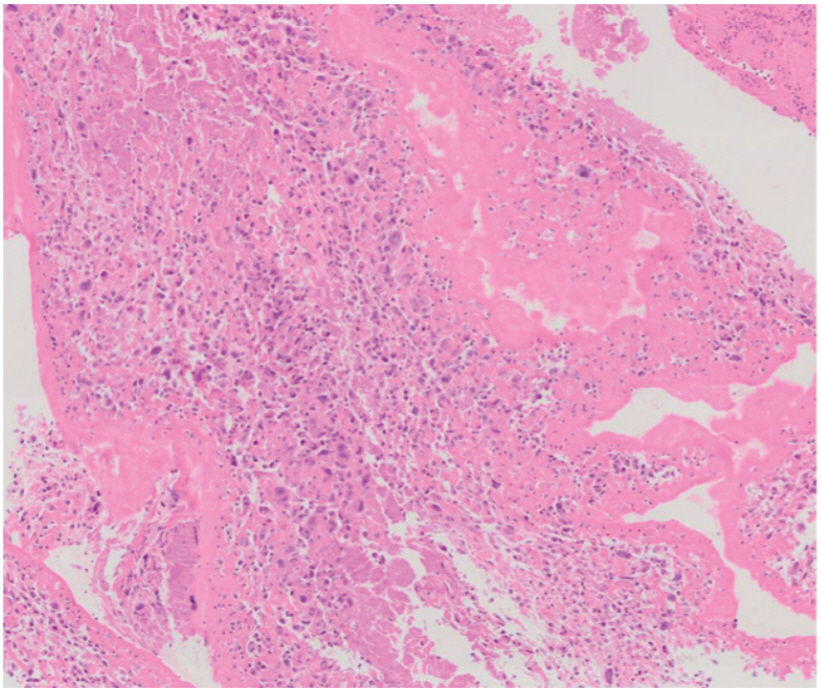
He was admitted with cardiac arrest on March 2016. The initial electrocardiogram revealed ST segment elevation (Fig. 1A), and coronary angiography showed total occlusion of the mid-left anterior descending artery caused by thrombus formation (Fig. 1B). Aspiration thrombectomy was successfully performed. The aspirated specimens were sent to the Department of Histopathology, and he was diagnosed with metastatic high-grade sarcoma (Fig. 2). Immunohistochemical examination confirmed a diagnosis of primary MFS. The patient was transferred to the oncology department for treatment.
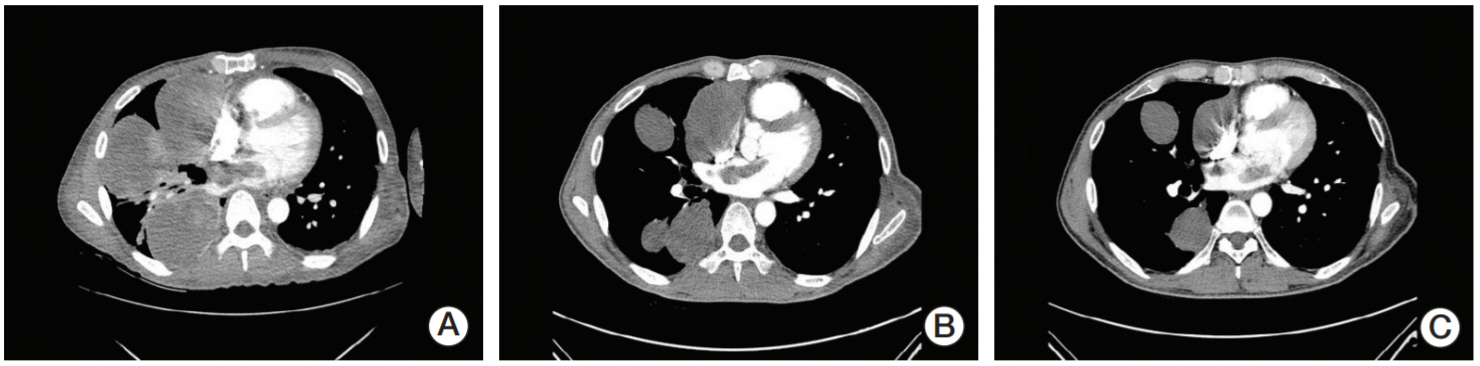
A computed tomography (CT) scan showed pulmonary vein and left atrium invasion from multiple lung metastases and that a coronary embolism from a lobulated mass in the left atrium caused the cardiac arrest (Fig. 3A).
Although the disease was in an advanced stage, the patient and his family desired palliative chemotherapy. Given the poor cardiac function, adriamycin-containing regimen was not suitable for chemotherapy. Thereafter, he received 2 mg/kg of pembrolizumab via intravenous infusion every 3 weeks. A partial response was achieved after two cycles of pembrolizumab (Fig. 3B). Moreover, his performance status improved, and the symptoms, including dyspnea and pain, completely subsided. CT images after four cycles showed a decrease in the size of the masses in both the lung and left atrium (Fig. 3C). He received ten additional cycles of pembrolizumab in an outpatient setting without any side effects. Unfortunately, the patient died from incidental intracranial hemorrhage after 18 months since receiving pembrolizumab.
Discussion
MFS is a subtype of soft tissue sarcoma, composed of malignant fibroblasts with a myxoid matrix. Currently, the World Health Organization recognizes MFS as a disease distinct from myxoid malignant fibrous histiocytoma [8]. The standard of treatment for MFS is a wide excision [2]. However, MFS shows high rates of local relapse after surgery; therefore, adjuvant radiotherapy should be performed. Unfavorable outcomes of MFS are associated with a large tumor size, deep location, high histologic grade, and positive resection margin [3].
Despite the efforts to control local recurrence, 15%-38% of locally relapsed MFS develop distant metastases [9]. Palliative chemotherapy could be used in patients with metastatic MFS; however, effective and standardized chemotherapeutic regimens do not exist because of its rarity.
We present the case of a patient with conventional chemotherapy-refractory metastatic MFS who received pembrolizumab as palliative immunotherapy. MFS lacks genetic and molecular evidence for using targeted chemotherapeutic agents. Pembrolizumab is a highly selective, humanized monoclonal IgG4-kappa isotype antibody against PD-L1. Anti‒PD-L1 antibodies can reverse negative immune regulatory signaling pathways of cytotoxic T cells. Pembrolizumab has shown robust clinical activity with an acceptable safety profile for various types of solid tumors [4].
In previous studies, biomarkers to predict clinical benefit from pembrolizumab were established. For example, preexisting CD8+ T cells in the tumor microenvironment were required for tumor regression after pembrolizumab [10]. Moreover, higher numbers of PD-1+ T cells at baseline and increased PD-L1 expression during treatment were associated with clinical response of receiving pembrolizumab [11]. The role of PD-L1 expression in soft tissue sarcoma was previously investigated. In one analysis, expression of PD-L1 was significantly associated with a poor outcome, especially in soft tissue sarcoma rather than bone sarcoma [12]. Another study demonstrated that PD-L1 expression was present in 15% of all sarcomas (34/222). By histologic types, undifferentiated pleomorphic sarcomas had the highest prevalence of PD-L1 expression; otherwise, MFS showed a negative PD-L1 expression [13].
Tawbi et al. [14] described that pembrolizumab showed clinically meaningful responses in patients with undifferentiated pleomorphic sarcoma or dedifferentiated liposarcoma, rather than bone sarcoma. Although no patients with MFS were enrolled in this study, one patient with chemotherapyrefractory MFS receiving nivolumab achieved complete response in another study [15].
To the best of our knowledge, this report represents the first evidence of pembrolizumab exhibiting efficacy against refractory metastatic MFS without any toxicity. In conclusion, we believe pembrolizumab could be an option for controlling metastatic sarcoma, including MFS without degrading the patient’s quality of life. Further studies of the efficacy and biomarkers of pembrolizumab for refractory metastatic sarcoma are warranted.
Fig. 1.(A) Electrocardiogram showing ST segment elevation in leads V2 to V5. (B) Coronary angiography image showing complete occlusion at the mid-left anterior descending artery (arrow).
Fig. 2.Histopathologic findings of aspirated specimens: anaplasia and pleomorphism of the nucleus compatible with high-grade metastatic sarcoma (H&E staining, ×40).
Fig. 3.(A) Baseline chest computed tomography (CT) image shows multiple metastatic lung mass with tumor invasion to the left atrium from the pulmonary vein. (B) Follow-up CT image shows a partial response after two cycles of pembrolizumab and a slight decrease in the size of the multiple masses in both the lung and left atrium. (C) Follow-up CT image shows a partial response after four cycles of pembrolizumab and a marked decrease in the size of the multiple masses in both the lung and left atrium.
REFERENCES
- 1. Lazaros GA, Matsakas EP, Madas JS, Toli DI, Nikas DJ, Kershaw MA, et al. Primary myxofibrosarcoma of the left atrium: case report and review of the literature. Angiology. 2008;59:632–5. ArticlePubMed
- 2. McMillan RR, Sima CS, Moraco NH, Rusch VW, Huang J. Recurrence patterns after resection of soft tissue sarcomas of the chest wall. Ann Thorac Surg. 2013;96:1223–8. ArticlePubMed
- 3. Kikuta K, Kubota D, Yoshida A, Suzuki Y, Morioka H, Toyama Y, et al. An analysis of factors related to recurrence of myxofibrosarcoma. Jpn J Clin Oncol. 2013;43:1093–104. ArticlePubMedPDF
- 4. Goldberg SB, Gettinger SN, Mahajan A, Chiang AC, Herbst RS, Sznol M, et al. Pembrolizumab for patients with melanoma or non-small-cell lung cancer and untreated brain metastases: early analysis of a non-randomised, open-label, phase 2 trial. Lancet Oncol. 2016;17:976–83. ArticlePubMedPMC
- 5. Zschabitz S, Lasitschka F, Hadaschik B, Hofheinz RD, Jentsch-Ullrich K, Gruner M, et al. Response to anti-programmed cell death protein-1 antibodies in men treated for platinum refractory germ cell cancer relapsed after high-dose chemotherapy and stem cell transplantation. Eur J Cancer. 2017;76:1–7. ArticlePubMed
- 6. Rexer H, Steiner T, Grunwald V. First-line therapy in advanced renal cell carcinoma: a randomized phase II study to examine early switch of tyrosine kinase inhibitors to nivolumab compared to continued tyrosine kinase inhibitor therapy in patients with advanced or metastatic renal cell carcinoma and stable disease after three months of treatment (NIVOSWITCH)-AN 38/15 of the AUO. Urologe A. 2017;56:509–11. ArticlePubMedPDF
- 7. Bellmunt J, de Wit R, Vaughn DJ, Fradet Y, Lee JL, Fong L, et al. Pembrolizumab as second-line therapy for advanced urothelial carcinoma. N Engl J Med. 2017;376:1015–26. ArticlePubMedPMC
- 8. Fletcher CD, Unni KK, Mertens F. World Health Organization classification of tumours: pathology and genetics of tumours of soft tissue and bone. Lyon: IARC Press; 2002. p. 102–3.
- 9. Nascimento AF, Bertoni F, Fletcher CD. Epithelioid variant of myxofibrosarcoma: expanding the clinicomorphologic spectrum of myxofibrosarcoma in a series of 17 cases. Am J Surg Pathol. 2007;31:99–105. ArticlePubMed
- 10. Tumeh PC, Harview CL, Yearley JH, Shintaku IP, Taylor EJ, Robert L, et al. PD-1 blockade induces responses by inhibiting adaptive immune resistance. Nature. 2014;515:568–71. ArticlePubMedPMCPDF
- 11. Weide B, Martens A, Hassel JC, Berking C, Postow MA, Bisschop K, et al. Baseline biomarkers for outcome of melanoma patients treated with pembrolizumab. Clin Cancer Res. 2016;22:5487–96. ArticlePubMedPMC
- 12. Zhu Z, Jin Z, Zhang M, Tang Y, Yang G, Yuan X, et al. Prognostic value of programmed death-ligand 1 in sarcoma: a meta-analysis. Oncotarget. 2017;8:59570–80. ArticlePubMedPMC
- 13. Kosemehmetoglu K, Ozogul E, Babaoglu B, Tezel GG, Gedikoglu G. Programmed death ligand 1 (PD-L1) expression in malignant mesenchymal tumors. Turk Patoloji Derg. 2017;1:192–7. ArticlePubMed
- 14. Tawbi HA, Burgess M, Bolejack V, Van Tine BA, Schuetze SM, Hu J, et al. Pembrolizumab in advanced soft-tissue sarcoma and bone sarcoma (SARC028): a multicentre, two-cohort, single-arm, open-label, phase 2 trial. Lancet Oncol. 2017;18:1493–501. ArticlePubMedPMC
- 15. D’Angelo SP, Mahoney MR, Van Tine BA, Atkins JN, Milhem MM, Tap WD, et al. A multi-center phase II study of nivolumab +/– ipilimumab for patients with metastatic sarcoma (Alliance A091401). J Clin Oncol. 2017;35 Suppl:Abstr 11007.Article
Citations
Citations to this article as recorded by

- Unveiling the myxofibrosarcoma tumor microenvironment: implications for immunotherapy
Cecilia Profumo, Massimiliano Grassi, Valentina Rigo, Matteo Mascherini, Paola Monti, Giorgia Arcovito, Giorgia Anselmi, Laura Damele, Giorgia Timon, Danila Comandini, Michela Croce
Frontiers in Immunology.2026;[Epub] CrossRef - Pembrolizumab and radiation therapy for multifocal myxofibrosarcoma of the scalp: a case report
Christopher Ryan Grant, Zhaohui Arter, Janellen Smith, Steven N. Seyedin, Mahra Nourbakhsh, Bonnie Lee, Andrew Creadore, Nataliya Mar
Therapeutic Advances in Medical Oncology.2024;[Epub] CrossRef - Microsatellite Instability and Clinical Use in Sarcomas: Systematic Review and Illustrative Case Report
Italo Fernandes, Douglas Dias e Silva, Vanderlei Segatelli, Renée Zon Filippi, Ana Carolina de Rezende, Paulo Campregher, Fernando Moura, Reynaldo Jesus-Garcia, Roberto Carmagnani Pestana
JCO Precision Oncology.2024;[Epub] CrossRef - Current Landscape of Immunotherapy for Advanced Sarcoma
Víctor Albarrán, María Luisa Villamayor, Javier Pozas, Jesús Chamorro, Diana Isabel Rosero, María San Román, Patricia Guerrero, Patricia Pérez de Aguado, Juan Carlos Calvo, Coral García de Quevedo, Carlos González, María Ángeles Vaz
Cancers.2023; 15(8): 2287. CrossRef - Modeling Myxofibrosarcoma: Where Do We Stand and What Is Missing?
Enrico Lucarelli, Alessandro De Vita, Chiara Bellotti, Tommaso Frisoni, Silvia Vanni, Ania Naila Guerrieri, Micaela Pannella, Laura Mercatali, Marco Gambarotti, Serena Duchi, Giacomo Miserocchi, Margherita Maioli, Chiara Liverani, Toni Ibrahim
Cancers.2023; 15(21): 5132. CrossRef - Pd-1, Pd-L1, Ido, Cd70 and Microsatellite Instability as Potential Targets to Prevent Immune Evasion in Sarcomas
Vasiliki Siozopoulou, Evelien Smits, Karen Zwaenepoel, Jimmy Liu, Abraham Pouliakis, Patrick A Pauwels, Elly Marcq
Immunotherapy.2023; 15(15): 1257. CrossRef - Clinico-demographic characteristics and outcomes of radiation-induced sarcomas (RIS): a CanSaRCC study
Mauricio Fernando Ribeiro, Hagit Peretz Soroka, Zainab Bhura, Ian Hirsch, Jay Wunder, Peter Ferguson, Kim Tsoi, Savtaj Brar, Rebecca Gladdy, Carol Swallow, Peter Chung, Charles Catton, Philip Wong, Geoffrey Watson, Albiruni Ryan Abdul Razak, Abha A. Gupta
Therapeutic Advances in Medical Oncology.2023;[Epub] CrossRef - Biology and Management of High-Grade Myxofibrosarcoma: State of the Art and Future Perspectives
Jun Nishio, Shizuhide Nakayama
Diagnostics.2023; 13(19): 3022. CrossRef - Targeted therapies and checkpoint inhibitors in sarcoma
M Vasella, E Gousopoulos, M Guidi, G Storti, S Y Song, G Grieb, C Pauli, N Lindenblatt, P Giovanoli, B -S Kim
QJM: An International Journal of Medicine.2022; 115(12): 793. CrossRef - Gemcitabine-Containing Chemotherapy for the Treatment of Metastatic Myxofibrosarcoma Refractory to Doxorubicin: A Case Series
Arielle Elkrief, Suzanne Kazandjian, Thierry Alcindor
Current Oncology.2021; 28(1): 813. CrossRef - Remarkable response to anti-PD1 immunotherapy in refractory metastatic high-grade myxofibrosarcoma patient
Yi Luo, Li Min, Yong Zhou, Fan Tang, Minxun Lu, Hongmei Xie, Yitian Wang, Hong Duan, Wenli Zhang, Chongqi Tu
Medicine.2021; 100(12): e25262. CrossRef - Is immunotherapy in the future of therapeutic management of sarcomas?
Ottavia Clemente, Alessandro Ottaiano, Giuseppe Di Lorenzo, Alessandra Bracigliano, Sabrina Lamia, Lucia Cannella, Antonio Pizzolorusso, Massimiliano Di Marzo, Mariachiara Santorsola, Annarosaria De Chiara, Flavio Fazioli, Salvatore Tafuto
Journal of Translational Medicine.2021;[Epub] CrossRef - Uncommon and peculiar soft tissue sarcomas: Multidisciplinary review and practical recommendations for diagnosis and treatment. Spanish group for Sarcoma research (GEIS – GROUP). Part I
Javier Martínez-Trufero, Josefina Cruz Jurado, M.Carmen Gómez-Mateo, Daniel Bernabeu, Luis Javier Floría, Javier Lavernia, Ana Sebio, Xavier García del Muro, Rosa Álvarez, Raquel Correa, C.Nieves Hernández-León, Gloria Marquina, Nadia Hindi, Andrés Redond
Cancer Treatment Reviews.2021; 99: 102259. CrossRef - Myxofibrosarcoma harboring an MLH1 pathogenic germline variant associated with Muir-Torre syndrome: a case report
Makoto Nakagawa, Eisuke Kobayashi, Masayoshi Yamada, Tomoko Watanabe, Makoto Hirata, Noriko Tanabe, Mineko Ushiama, Hiromi Sakamoto, Chiaki Sato, Taisuke Mori, Akihiko Yoshida, Teruhiko Yoshida, Kokichi Sugano, Akira Kawai
Hereditary Cancer in Clinical Practice.2021;[Epub] CrossRef - A combination of irinotecan/cisplatinum and irinotecan/temozolomide or tumor-targeting Salmonella typhimurium A1-R arrest doxorubicin- and temozolomide-resistant myxofibrosarcoma in a PDOX mouse model
Tasuku Kiyuna, Yasunori Tome, Takashi Murakami, Kentaro Miyake, Kentaro Igarashi, Kei Kawaguchi, Hiromichi Oshiro, Takashi Higuchi, Masuyo Miyake, Norihiko Sugisawa, Zhiying Zhang, Sahar Razmjooei, Sintawat Wangsiricharoen, Bartosz Chmielowski, Scott D. N
Biochemical and Biophysical Research Communications.2018; 505(3): 733. CrossRef